Justice for All holds a workshop on the personal status law for Al-Quds Open University students in Gaza
Gaza, Publication and Information Unit:
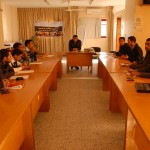
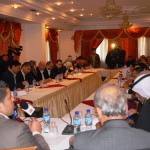
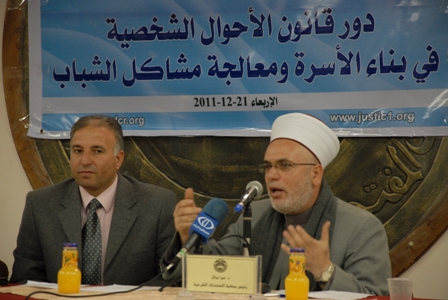
The Justice for All project at the Palestinian Center for Democracy and Conflict Resolution held a workshop entitled "The role of the personal status law in building the family and addressing young people's problems", in cooperation with Al-Quds Open University in the Gaza governorates. The workshop was held at the university's premises in Gaza City on 21/12/2011 with the participation of a number of university students and interested people.
At the start of the workshop, the projects director at the Conflict Resolution Center, Abdel Moneim Al-Tahrawi, stressed that the Justice for All project aims at building the capacities of those charged with law enforcement in order to ensure the rule of law is strengthened in Palestinian society. He noted that the Centre works to build a society free of violence through three main programmes, namely awareness, capacity building and mobilisation, by coordinating with organisations, centres and associations within society.
For his part, the coordinator of the rule of law and justice project at the United Nations Development Programme (UNDP), Ibrahim Abu Shamala, explained that society is in urgent need of empowering some fragile social groups such as women and young people, in addition to the legal ignorance among these groups about the rights guaranteed to them by law. He added: "Social justice must be provided for women and violence against them stopped, and likewise the personal status law needs real application and enforcement within society."
For his part, Dr. Omar Nofal, president of the Court of Appeal and member of the Supreme Sharia Court, explained that Islamic law came in order to achieve people's interests, to address human rights, to apply social justice and to ease family relations. He explained that applying the personal status law requires young people's awareness and their knowledge of all the issues, that the law stands beside them, and that the sharia courts will always work to support the founding and success of the Palestinian family.
On the issue of early marriage, Dr. Abdel Hafez Shehada, a university lecturer, pointed out that Palestinian legislation has given the right to marry girls under the age of 17 on condition that no one under the age of nine is married, and that unfortunately divorce cases arising from early marriage exist and to a noticeable degree. He said: "Among the most prominent causes of divorce in cases of early marriage is the weak educational and intellectual level of the husband and the wife's failure to understand the requirements of the new stage, and therefore legal and social awareness of this phenomenon must be increased."
During the workshop, the participants asked about a number of issues relating to marriage, inheritance and early childbearing, and also learned about the main laws concerning their rights when forming a family, the legal procedures in cases of divorce, and the legal culture young people need within the local community.
It is noted that the Justice for All project carries out its activities and programmes in partnership with the United Nations Development Programme (UNDP), with the aim of strengthening the concepts of the rule of law and justice for a number of social groups, so as to build a society able to face challenges and to strengthen the social fabric.