Palestinian Center for Democracy and Conflict Resolutionالمركز الفلسطيني للديمقراطية وحلّ النزاعات (PCDCR)
New release
Peer-reviewed field study
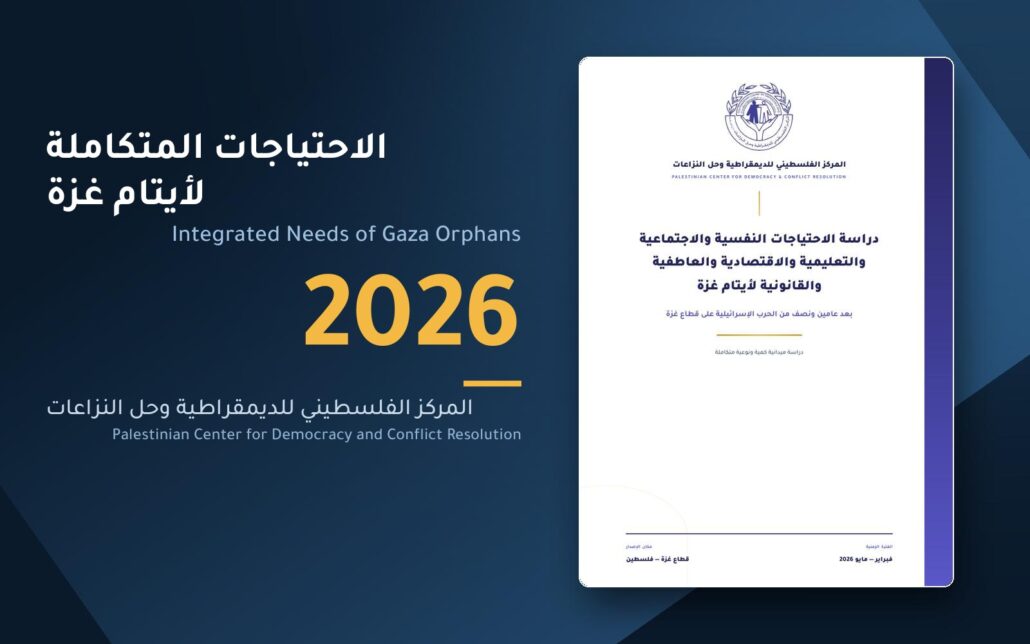
The Psychological, Social, Educational, Economic, Emotional and Legal Needs of Gaza's Orphans After Two and a Half Years of War
A field study combining quantitative and qualitative approaches to document the lives of orphans in displacement camps, translating its findings into practical intervention pathways and legal reforms that redefine who is entitled to care.
671 orphaned children11 in-depth interviews7 focus groups (~60 children)6 dimensions of need
The Palestinian Center for Democracy and Conflict Resolution has released a large-scale field study of the needs of Gaza's orphans two and a half years into the war. The study uses a mixed-methods design that brings together 671 orphaned children with in-depth interviews and focus groups that carry the child's own voice, so that it reads the wound from the inside, not from the numbers alone.
The central finding is striking in its simplicity: the median orphan in the sample sits exactly at the clinical referral threshold, meaning that disorder has become the norm, not the exception. This is a population-level crisis, not individual cases waiting for a clinic, and its signature is silent and internalising, hidden by aggregate scores; the most vulnerable are sole survivors and maternal orphans. The study concludes with four service components and a structural reform built on whole-family care and redefined entitlement around need for care.
Key Figures
SDQ-2553.65%above the psychological referral threshold; the mean (17.23) equals the threshold itself
War orphanhood89.87%lost a parent to the war: compound trauma, not ordinary orphanhood
CRIES-888.24%of sole survivors are above the post-traumatic stress threshold
Internalising signature68.41%above the emotional subscale threshold: a silent wound beyond what the total score captures
Caregivers81.22%of caregivers themselves report needing psychological support
Shelter76.45%live in tents, and the tent is an independent psychological risk factor
Geographical Distribution of the Samplen = 671
1Gaza Governorate397 children59.17%
2North Gaza163 children24.29%
3Deir al-Balah111 children16.54%
◆Fieldwork covered the northern and central governorates (safe access to Khan Younis and Rafah was not possible). For comparison with the reference population structure (PCBS 2023): Gaza 51.7% · North Gaza 27.6% · Deir al-Balah 20.7%.
Key Recommendations
1Mobile psychological first-aid and screening unitsthat go to the child with non-stigmatising activities (play, drawing and storytelling), and screen by subscale and CRIES, not by the total score alone.
2Whole-family carethat brings mothers into every intervention and supports exhausted caregivers, with no less than 30% of programme resources.
3Inclusion in learning spaces and protection of boyssince education is the strongest protective factor, with an alternative path of meaning that fills the father's absence before revenge does.
4Redefining orphan entitlementaround “need for care” rather than “loss of the breadwinner”, to do justice to maternal orphans and the administratively invisible “de facto orphan”.
5A regular cash lifeline, and shelter as advocacy, not a promiseMaterial support is the first stated need (85.10%) and the gateway to ending child labour.
6Training specialised staffwho can detect the silent wound and manage screening and debriefing, the foundation that comes before everything else: “no screening without a trained eye”.