The Palestinian Center holds a round table entitled "Including the children of prisoners serving long sentences"
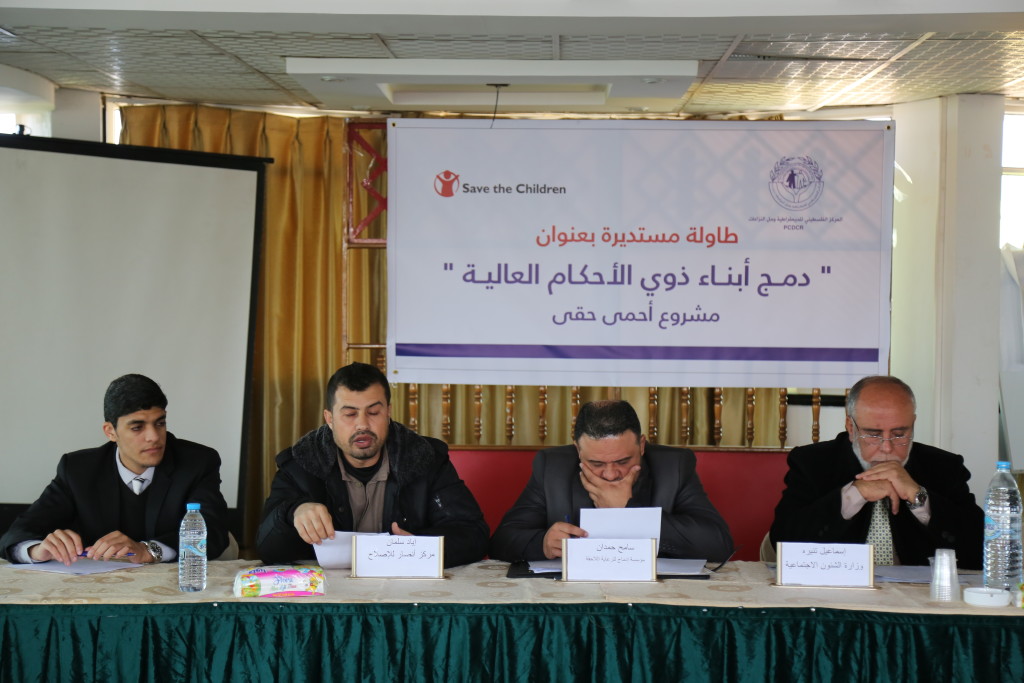
The Palestinian Center for Democracy and Conflict Resolution today held a round table entitled "Including the children of prisoners serving long sentences", as part of the events of the "Protect My Right" project, funded by Save the Children International, which aims to form groups for monitoring and documenting violations of children's rights.
Colonel Iyad Salman, head of the Ansar Rehabilitation and Reform Centre, took part with a paper on the role of the rehabilitation and reform centre in easing the burden on the families of those serving long sentences, particularly their children. He said the public relations department of the Ansar Rehabilitation and Reform Centre had compiled figures for 2015 showing that married inmates accounted for 61%, that is around 183 of the 320 inmates held, among them 131 serving one-year sentences (43%) and 55 serving two years or more (22%), and that the number of children recorded for them is close to 130 children under the age of 12.
He said that the families of inmates are a fragile and marginalised group, having lost the family breadwinner and with it many of their needs, and are in need of a great deal of follow-up and of social, educational, health and psychological care. He therefore recommended strengthening communication with all the bodies concerned, whether the Ministry of Social Affairs, the Ministry of Education or civil society organisations, to meet the needs falling on them in this respect, and helping the children of inmates to strengthen their social structure by easing the negative feelings that affect family members, such as shame, anxiety and humiliation, which lead to further problems facing the family, the most serious of them being the family's refusal to take the inmate back after release.
Mr. Ismail Tanira, director of the social protection department at the Ministry of Social Affairs, also took part with a paper on the ministry's role in caring for inmates' families. He explained that the question of inmates' families and their children is not a new one for the Ministry of Social Affairs but has been dealt with for a considerable time, and that a number of departments attend to the affairs of inmates and their families from several angles, whether social, economic or educational, providing financial support and psychological and social counselling and guidance to inmates' families.
Mr. Sameh Hamdan, chair of the board of the Idmaj Aftercare Association, took part with a paper on the role of civil society organisations in improving the situation of the children of inmates serving long sentences. He explained that the crime rate in the Gaza Strip is steadily rising, with 470 inmates serving sentences of more than a year, 192 serving five years or more and 114 serving ten years or more. He also said that 73 inmates are serving sentences on charges of collaboration and 63 on charges of murder, and that the children of inmates in prison number 500 under the age of 18.
Hamdan recommended the need for a comprehensive government programme based on cooperation and the joining of efforts between all the competent bodies to secure the rights of inmates and their families, taking into account the psychological, social, economic, medical and moral effects falling on families and children as a result of the imprisonment of their relatives. He warned of the grave consequences of those effects, which could produce child offenders and criminal families as a result of neglect, marginalisation and the failure to provide the necessary help.
The participants in the discussion made several recommendations, the most important being to intensify efforts between all governmental and non-governmental institutions to secure the best interests of prison inmates and their families; to follow up their families' psychological, humanitarian, health and living conditions; to arrive at a programme inside the rehabilitation and reform centres based on integrated protection for prisoners' families; to activate a number of the rights provided for in the law, including providing work opportunities for inmates during their sentences that allow them to support their families; and to build a database on the number of prisoners, the nature of their cases and the length of their sentences, together with all details of their families, including where they live, their number and their economic and social situation.
They also called for a greater role for the Ministry of Education and the Ministry of Social Affairs with regard to inmates' children, by including them in all programmes and plans so that these children can be followed up educationally, in addition to providing intensive psychological and social support and counselling that ensures their social inclusion and protects them from the risk of delinquency.
They stressed in conclusion the need to spread awareness through all governmental and non-governmental institutions, and particularly media organisations, that the family of an inmate or offender should not be punished socially or cast out and stigmatised because of the wrong the offender has committed, so that we do not drive them into becoming a criminal family with children who offend.