The Palestinian Center holds a dialogue meeting on widows and orphans
Gaza, Publication and Information Unit
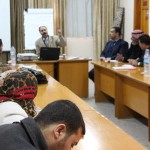
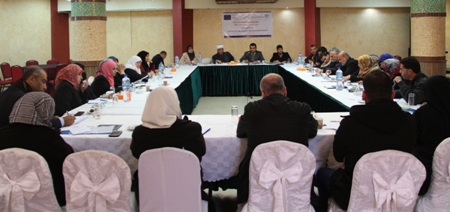
At midday today the Palestinian Center for Democracy and Conflict Resolution held a dialogue meeting entitled "Widows and orphans: difficulties in obtaining rights and hopes of overcoming them for a decent life", within the events of the project "Strengthening and improving women's rights to housing, land and property in the Gaza Strip", funded by the European Union (EU). The meeting was opened by lawyer Younis Al-Tahrawi, head of the legal unit at the Palestinian Center for Democracy and Conflict Resolution, who welcomed the participants and the meeting's guest, Dr. Hassan Al-Joujou, president of the High Council of Sharia Judiciary. Dr. Hassan Al-Joujou said that the problem with the dues of widows and orphans lies not in the law or the procedures followed, but in the management of those funds. He stressed that the Sharia Judicial Council has issued many instructions concerning the funds of orphans and minors, a series of legal procedures whose aim is scrutiny and oversight in the best interests of orphans. He pointed to the need to hold to account lawyers who conclude contracts of sale for the shares of minor orphans through a guardian or trustee when the transaction is incomplete from the sharia and legal standpoint, given the resulting loss of and encroachment on orphans' rights, which is unacceptable both in sharia and in law.
Many questions were put to him by the participants, among them a question from the wife of a martyr concerning the procedure for authorising the disbursement of minors' funds by the guardian, even though she is the one with custody of the martyr's children. He answered that authorisation to disburse minors' funds goes through several legal steps and procedures, beginning with the submission of the application by the guardian or the custodial parent, passing through the court of first instance and ending with the transaction being placed before him at the Sharia Judiciary Office for scrutiny and approval.
For his part, lawyer Ahmed Hassouna of the Palestinian Center focused his remarks on two points. The first concerns the differences between the decisions issued on the dues of widows and orphans as to who receives them and how they are distributed, whether these decisions are issued by official bodies such as the Ministry of Social Affairs, the sharia courts, the Palestine Scholars Association and the Insurance and Pensions Authority, or by unofficial bodies such as the charitable societies and organisations concerned with the cases and dues of widows and orphans. This gives rise to many disputes between the relatives of orphans and widows and every interested party.
In his second point, lawyer Hassouna pointed to dealings in the (real estate) assets of minor orphans, such as sale and exchange and the like, by the guardian, trustee or custodial parent in an unlawful manner and without following the procedures in force in this respect, which gives rise to many disputes before the courts, both now and in the future.
The meeting concluded with a number of recommendations, namely:
1. The need for coordination and networking between all governmental and non-governmental organisations working in this field in order to address these problems.
2. Focusing on raising the awareness of widows as a group about their rights and duties.
The need for a media campaign advocating for orphans with regard to their funds deposited with the orphans' fund.