Conflict Resolution discusses the effect of the political division on groups in society in Nablus governorate
Nablus, Publication and Information Unit:
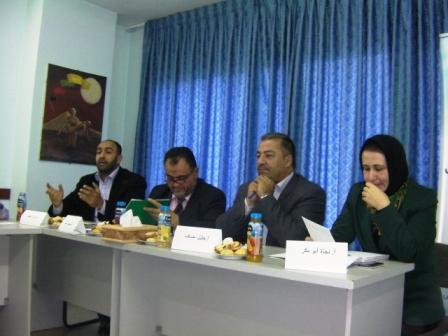
The Palestinian Center for Democracy and Conflict Resolution discussed the political effects of the division between the West Bank and the Gaza Strip on groups in Palestinian society, among them young people, women and prisoners. These discussions took place during a round table held by the Coalition of Civil Forces for Civil Peace project at the Conflict Resolution Center branch in Nablus governorate, with the participation of a group of public figures and representatives of the factions and civil society organisations.
At the start of the meeting, the director of the Centre's branch, Ahmed Abu Ayyash, spoke about the role of the Palestinian Center for Conflict Resolution in establishing the principles of civil peace in order to strengthen the role of community reconciliation, and about the main plans and solutions the Centre has put to the Fatah and Hamas movements to end the division.
For his part, the head of the gathering of independent figures in the West Bank, Khalil Assaf, stressed that the time has come to end the division, which has fragmented the Palestinian social fabric, and the need to protect the Palestinian people from the negative effect of the division, whose consequences are no less than the practices of the occupation.
For her part, the MP Najat Abu Bakr, member of the Legislative Council for the Fatah Movement, called for activating and involving Palestinian women in strengthening community reconciliation, and said young people should take the initiative in pressing decision-makers to end the division and in seeking to bring about genuine and substantial change to save Palestine.
On the conditions of political detention in the West Bank and Gaza, the former minister of prisoners' affairs, Eng. Wasfi Kabha, called for closing this file and for citizens not to be detained on the basis of their political background, as well as for working to apply the Prisoners' Document of 2006, which calls for ending the division completely, and for strengthening the language of dialogue and participation between the Fatah and Hamas movements and the other factions in order to emerge from this serious crisis.
For his part, the director of the Ahrar Centre for Studies, Fouad Al-Khaffash, praised the youth movements that are trying to press all parties to entrench national reconciliation and to make use of young people's energies within it, and encouraged the holding of continuous meetings between the disputing parties in the Fatah and Hamas movements in order to break down barriers, bring views closer together and seek to reach a bright picture for the future of the Palestinian people.