Conflict Resolution holds a meeting on arbitration and its role in strengthening the rule of law
Gaza, Publication and Information Unit:
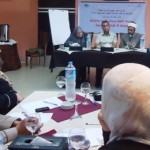
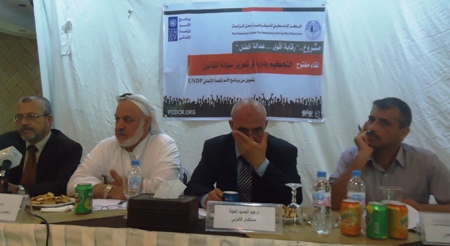
The Palestinian Center for Democracy and Conflict Resolution held a meeting at which it hosted the legal counsel Hisham Kalakh, Dr. Abdel Hamid Al-Aila, Dr. Salem Salama, head of the fatwa department at the Palestine Scholars Association, and Iyad Abu Hjair, deputy director of the Conflict Resolution Center, Gaza branch.
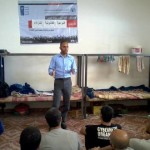
The meeting centred on arbitration and its role in strengthening the rule of law, and was attended by a number of notables, mukhtars, organisations, lawyers and media professionals.
This meeting comes within the activities of the project "Stronger oversight, better justice", funded by the United Nations Development Programme (UNDP).
Anwar Azzam, the project coordinator, said these meetings aim to discuss the reality of the justice system in order to ensure that the rule of law and justice are strengthened in Palestinian society, to improve the justice bodies in society and to build a society able to face the challenges.
Dr. Salem Salama explained that 15,350 cases have been resolved through arbitration, that an arbitrators' decision is not subject to appeal and that the ruling cannot be objected to, though the procedures or the hearing of witnesses may be challenged.
He added that for two years the Association has been working on training the arbitration committees within its reconciliation committees in order to enrich their legal culture and refine their capacities and abilities from a legal standpoint, so that they can carry out their role in adjudicating and reconciling between people in a way consistent with Islamic law and with the courts, and so that all the decisions they issue are ratified, without either party to a dispute being able to annul the reconciliation decision.
In the same context, counsel Hisham Kalakh spoke about the ways of forming an arbitration panel, whether by the disputing parties or by others, and the conditions an arbitrator must meet, in addition to the arbitration agreement and the conditions for its validity.
At the end of the meeting the floor was opened for discussion between the guest speakers and those present, and they produced several recommendations, among them that an arbitrator must obtain a licence approved by the Ministry of Justice, and that a legal expert should be engaged, particularly in institutional arbitration, because arbitration is the other face of authority.
It is worth noting that this meeting comes within a series of meetings held by the Palestinian Center for Democracy and Conflict Resolution within the project's events, with the aim of discussing the reality so as to arrive at practical and swift solutions to some of the difficulties citizens face.