Rahma is bound in chains. Will she find anyone to help her, unchain her and show her mercy?
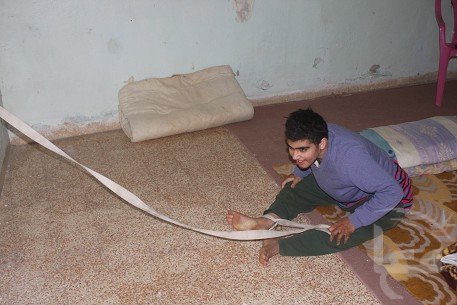
Tulkarm, Ma'an report: Rahma is a girl of 17 who is bound in chains and left in her decaying, foul room in one of the alleys of the town of Deir Al-Ghusun north of Tulkarm, not for any wrong she has committed but because she was born with an intellectual disability.
It is a scene the pen is unable to draw and the cameras unable to uncover, but the eye takes in everything, small and large: her movements, her looks, her groans and the chain placed on her leg and reaching to the room's window and only a certain distance so that she cannot go beyond it, accompanied by sores and groans and a sound that is neither weeping nor screaming, as though they were the sounds of a human being who never learned that speech is part of human nature.
The girl Rahma lives in a house not fit for human habitation, even if she has accepted it: a foul smell, furnishings piled up everywhere, crumbling walls and ceilings on the verge of collapse at any moment. Her father died four years ago and she was left with her elderly mother, who has treated and cared for her badly because of the many circumstances surrounding her.
There is no provider and no partner to ease for her the darkness of the nights and the loneliness of the long days. When her mother wants to leave the house to run errands in the town, she locks the door firmly and tightens Rahma's chain "so that she does not go out and cause problems for those around her".
The mother, Fatima Abdel Latif Ali, says she informed social affairs about her daughter Rahma's situation, and that Rahma is paid a sum of 1,000 shekels every four months, which is not enough, since the shopkeepers demand payment from her, as does the owner of the house, apart from Rahma's daily needs.
And when I asked: does the social affairs department know that you tie her up inside her room? She answered: yes, they know, and they told me not to tie her up, but I cannot untie her for fear of her behaviour and of her leaving the house.
It is a justification that finds no echo among many around her, but she added: "When I untie her chain and she stands at the door of the house, she meets mockery and harassment from passers-by and from some of the boys in the neighbourhood, and often she takes off her clothes and her body is exposed."
For his part, Hazem Omar, an employee of the Deir Al-Ghusun municipality, said: "We have known Rahma's mother for a long time and we work to help her, and many friends are good to her and provide her needs of bread, food and even nappies for her daughter Rahma", explaining that the sum of 1,000 shekels she receives from social affairs does not meet the need.
Omar added that what is needed is the intervention of organisations and official bodies to end Rahma's suffering, whether by caring for her and placing her in a care and rehabilitation centre or otherwise, stressing that the scene is very hard and that the living conditions Rahma endures are much harder, with her father's death, the absence of any siblings, and her mother's indifference under many flimsy and unjustified pretexts.
Omar asked: where are human rights? Indeed, where are women's rights, of which Rahma is a part? Indeed, where is humanity?
Rahma was born a nine-month baby to a poor "musahharati" (the man who wakes people for the pre-dawn meal in Ramadan), who married Fatima, who bore him three daughters, Rahma being the fourth, since Fatima was not blessed with sons.
The poor musahharati does not seem to have sensed that the girl was not like her sisters, although no signs of disability appeared in her at birth. He named her Rahma (mercy), as though he knew what misfortunes of fate would befall her, so that perhaps her name would move human beings to show her mercy if her condition did not lead to that.
Rahma grew up in her parents' care until her father died when she was 14, and she continued to suffer her life with her mother, who married another man in the hope that he would provide care and protection for her and her daughter. But the man was nothing but a new burden, and he shared with Rahma and her mother the crumbs of food and the charity of well-wishers, and his repeated illness made matters worse.
At last Fatima found an old house in the town of Deir Al-Ghusun inhabited by snakes and rats, and she was glad of it even though it had no doors. But the absence of doors tempted the neighbourhood's boys, who kept mocking the girl, stealing glances at her exposed body and pelting her with stones and rubbish.
So the mother set about looking for another house, and this time she found an old house with a door, and she promised to pay its rent from the European Union grant that was restored to her after her divorce from her second husband. This grant became the mother of promises: from it the rent would be paid and from it the debts to the shops, the bakery, the doctor and the pharmacy would be settled, and this grant, 1,000 shekels every four months, cannot meet a single one of these obligations.
No one has shown Rahma mercy, for the house she lives in is empty of all the essentials of life: no water and no trees, no gas and no people. Even her mother's husband stipulated that she leave Rahma if she wanted him as a husband, the neighbourhood's people curse the day she came to live among them, the owner of the house searches tirelessly for the rent, and the prepaid electricity meter soon completes the scene, so that darkness falls.
Is there any mercy for Rahma? This is a cry to all officials and to those running rights and social associations.
Rahma has no intermediary, and she is not an electoral vote. Rahma is a broken body, Rahma is a human being living the life of an animal, Rahma has lost every human right: family violence, disability, no security and no safety, no shelter and no food. So have you any heart and any mercy for her?