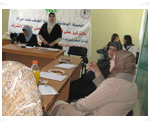
A meeting on protecting women's rights and rejecting the violence practised against them
Nablus / Zein Asqalan / Al-Ruwwad for Press and Media
A meeting was held at the Hawwa Centre for Culture and Arts in Nablus governorate, bringing together a number of psychologists, social centres and official bodies. This meeting comes as a continuation of the activities of the national campaign to combat violence against women, launched by the Palestinian Center for Democracy and Conflict Resolution in partnership with the Palestinian NGO Network. The facilitator Raed Sanaqra opened the meeting with a simple talk about violence and mentioned some statistics on violence in the countries of the world in general and in Palestine in particular.
Dr. Maher Abu Zant said that violence in Palestine cannot be considered a phenomenon, because a phenomenon, as he described it, is the widespread occurrence of a behaviour among a group of the members of society, and it exists in some countries of the world, but in Palestine it is a problem, where it is noticeable that cases of violence against women have decreased compared with the past two years. Dr. Abu Zant added that Palestine, unlike advanced societies, suffers from bad conditions present in society, whether economic, social or otherwise, since the matter of beating a woman or assaulting her is not as it is in foreign countries; rather the man in Palestine resorts to beating because of external circumstances. Dr. Maher then added that this does not mean that there are no cases of violence in Palestinian society, and explained that many studies and opinion polls have been carried out abroad on the view of women and found it to be a materialistic view that regards the woman as a promoter of some commodity, unlike the case in Palestinian society, where the woman enjoys respect and esteem. He added that linking the woman to violence is a mistake, as is looking at the woman as wronged and a victim in all cases; rather the issue must be looked at with a broad view, and he explained that violence has forms.
First lieutenant Maysara Maqboul, deputy director of public relations at the Nablus police, said that the figures on cases of assault that reach the police are in reality higher, since there is a dark figure that is not known and remains hidden, and that 98% of killings on the grounds of honour are accompanied by the mutilation of the body. She said that the law applied in Palestine is a Jordanian law dating from 1960, or the English law dating from 1927
For her part, Amal Al-Ahmad, social researcher at the Women's Studies Centre, spoke about family violence and how long we will go on talking about the subject with no solution. Alia Al-Asali spoke about the phenomenon of violence in schools by pupils and by teachers as well, and that its cause is a misunderstanding of the law banning beating in schools, that is, there is a double standard in the criteria and the laws. She added that the existing statistics on the subject of violence are not accurate, for there is a problem with the sample and with the way the question is put, since the sample needs a precise scientific reference study, and that before every statistic the terms (violence, for example) must be defined, for every person defines violence according to their personal perspective, and violence is a reflection of another violence and is a human phenomenon whose roots begin with culture. She added that change in this phenomenon can only come about through a reverse process by setting new laws. Hamed Abu Thabet, director of public relations at the Hawwa Centre, stressed the need for the work of civil organisations to be a link on two popular levels. The meeting concluded with a number of recommendations, the most important of them being that the police adopt forensic examination, the creation of a centre that acts as a lever for women's concerns and problems, and the issuing of legislation relating to this subject.