Specialists call for uniting the efforts of new media to reunite the two parts of the homeland
Gaza, Publication and Information Unit:
Specialists called for serious work on uniting media efforts and social media in order to end the political division, to strengthen the language of dialogue between young people and the local community, and to focus on increasing mobilisation to address national issues that command full consensus among all groups and organisations.
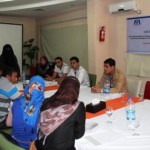
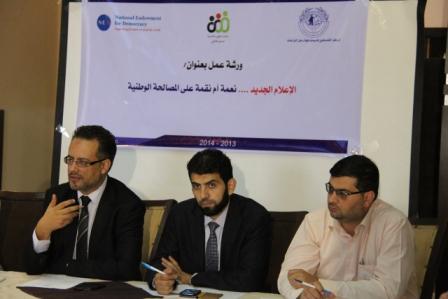
These calls came during a workshop held yesterday by the Coalition of Civil Forces for Civil Peace at the Palestinian Center for Democracy and Conflict Resolution, with the participation of a group of media professionals, bloggers and representatives of civil society organisations in the Gaza governorates.
On the importance of the meeting, the coordinator of the Coalition of Civil Forces project, Hanan Al-Dalu, explained that Palestinian young people have used social media to influence the question of reconciliation, but that all these attempts have not succeeded effectively on the ground. She added: "At the Centre and within the Coalition of Civil Forces we hope there will be a greater contribution from social media in the future, through increasing awareness and education in using these tools, which we hope will affect the course of community reconciliation in Palestine."
For his part, the media professional Mohammed Abu Sharkh pointed out that social media have allowed everyone to express their opinion away from government interference, and that the main reason behind the failure of reconciliation initiatives and events is that they take on a party character, as he put it. He explained that using the new media properly will help entrench reconciliation among people within Palestinian society.
For his part, the media professional and blogger Khaled Safi said that public awareness through modern technological means is one of the ingredients of success, and that the results of that awareness will establish successes and new horizons, whether on the question of reconciliation or others. He added: "Our society suffers from a failure to accept differing views, and this shows plainly in the statements and point-scoring that take place between individuals and factions, even through social media."
On the effect of social media on national issues as a whole, the community activist Muheeb Shaath stressed that the Palestinian cause in all its aspects, including prisoners, Jerusalem and Israeli violations, receives comments and attention from politicians and young people on social media, which increases the level of support and advocacy for the Palestinian people. He called for seizing opportunities and increasing the number of media campaigns aimed at restoring cohesion between the West Bank and the Gaza Strip and at standing firm in the face of all internal and external challenges.
During the workshop, the participants called for forming an informal media grouping to seize the opportunity of social media and increase its influence in creating a state of community reconciliation among people, as well as producing films and new media material focusing on tolerance, respect for others and strengthening national unity.