Conflict Resolution Center holds a round table meeting on ways of enacting a minimum wage in the West Bank governorates
Nablus, Publication and Information Unit:
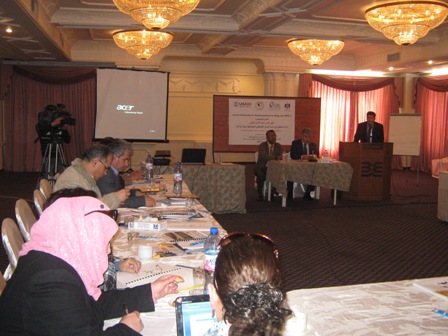
The Palestinian Center for Democracy and Conflict Resolution, in cooperation with the Palestinian Ministry of Labour in the West Bank, held a round table session entitled "Horizons for enacting a minimum wage", within the Active Citizenship project for adopting a minimum wage, in cooperation with Catholic Relief Services and with funding from the United States Agency for International Development (USAID).
The participants examined ways of pressing the three parties to production concerned with workers' issues to adopt and enact a minimum wage, and reviewed the study the Conflict Resolution Center carried out on this question. Taking part in the meeting was the wages committee, made up of 15 members chaired by the minister of labour Dr. Ahmed Majdalani of the government in the West Bank, with the participation of 11 representative bodies, among them representatives of the ministries, the federation of chambers of commerce, a group of workers' and trade unions, the national committees for the employment of women and the private sector coordinating council.
On the Ministry of Labour's vision for enacting a minimum wage, Minister Majdalani stressed that the study set out many strong points that help officials in dialogue and can be relied on with those concerned, taking into account the level of poverty, the unskilled worker and the level of wages in the most affected sectors compared with other sectors. He called on the wages committee to attend to and focus on the study's recommendations, considering it one of the most important studies that can be relied on in enacting a minimum wage in the coming period.
The Conflict Resolution Center, with the director of the Centre's Nablus branch Ahmed Abu Ayyash present, then gave an analytical summary of the study in a way that links the figures and results it produced with a focus on the reality of life and the suffering the Palestinian worker faces daily. The floor was then opened for dialogue and discussion about the study, whose importance and practical results those present agreed on as reflecting the true reality of workers in the Palestinian territories.
The discussion during the round table meeting focused on reviewing the study's main recommendations, among them setting a minimum wage and social protection, adopting the poverty line as the level of the minimum wage, forming courts specialising in labour disputes, seeking to increase educational activity for workers about their rights and laws, in addition to treating working women fairly with more support and equality in wages, and stressing the need to move the question of the minimum wage from an economic issue to a humanitarian and moral one based on fairness and social justice.
The participants called on the management of the Conflict Resolution Center to adopt a set of recommendations, among them widening the study to cover the level of consumption and expenditure of the Palestinian family and surveying public opinion in more governorates in any future studies in the coming period, among them Ramallah governorate.