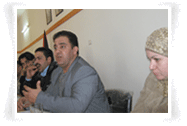
A workshop in Tubas targeting officials and decision-makers
A workshop was held in Tubas governorate on the national campaign to combat violence against women. The workshop was attended by a number of representatives of official bodies and of the centres concerned with women's issues, figures from the general investigation department and a number of specialists in this field. The workshop was opened with a speech given by the session's facilitator, Wurud Yassin, the workshop's coordinator, in which she spoke about the project of the national campaign to combat violence against women and showed the project's importance and its aims. Atef Awad, academic supervisor at Al-Quds Open University, said that customs and traditions are what govern us and not religion in many cases, and that the basis is the family, social upbringing and awareness, for society is quick to judge the victim. Youssef Rashid from the general investigation department confirmed that the problem lies in the raising and upbringing of the generation, so we must as far as possible amend the way we raise our children. Izdihar from the Palestinian Red Crescent Society added that family violence is what makes children go out into the street and be subjected to violence and assault, and that violence is not necessarily by beating; rather there are many forms of violence. Faida Dabak, head of a women's centre in Tayasir, added the need for awareness-raising, and that this is a role falling on the organisations to hold awareness workshops for men and young people of a young age, as well as workshops bringing together fathers and children. Awad added that the media has a role in combating violence, and that the satellite channels are one of the causes that encourage violence in general.
On the religious side, Rashid confirmed that the woman has a special standing and respect derived from the Islamic religion, for the basis is religion and therefore we must start from it, while trying as far as possible that religion should not be understood wrongly. He stressed the need for follow-up and communication between the family and the school, for the Islamic religion has provided the solution to all these subjects and others.
The workshop included several ideas, among them producing family education programmes for mothers, and that the workshops on violence should include an outline of the penal code. More than two thirds of those present agreed that the cause of violence is the woman's ignorance and her lack of knowledge of her rights and duties and her confused understanding of rights and duties. Rashid explained that there is no text in the law that contradicts the Islamic religion and that the law does not discriminate between men and women in legal judgment. Those present commented on the importance of protecting the victim in some cases, particularly those in which she is killed by the family.
The workshop concluded with several recommendations, the most important of them establishing a safe house for abused women, particularly in the Nablus area, and establishing a family court (specific to the family), in addition to the existence of marriage counselling offices, that the punishment of the assailant should be a just punishment in cases of killing on the grounds of honour, and working on establishing a body that demands women's rights properly, along with establishing a law that protects children in cases of family violence.