A workshop to discuss the social effects resulting from the division
Gaza, Publication and Information Unit:
Palestinian society is known for its unity, its cohesion and its solidarity, and the scene most indicative of that is the Palestinian family's embrace of any Palestinian resistance fighter before the internal division, for when the door of the house was opened to a fighter seeking protection, the family, down to its youngest member, was keen to protect him and to extend a helping hand to him, and there was no difference between a son of Hamas and a son of Fatah, for all of these are sons of the Palestinian people and this enemy will certainly turn its weapon on every Palestinian on this land. But this beautiful picture was disfigured by the division in Palestinian society in 2007 after the legislative elections.
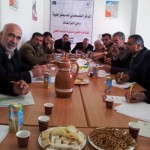
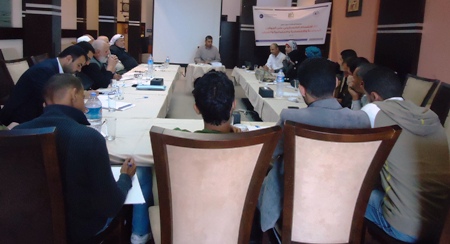
On the extent of the division's effect on social aspects, the Palestinian Center for Democracy and Conflict Resolution, within the team of the coalition of civil forces for civil peace, held the second workshop of the series of workshops the Conflict Resolution Center intends to hold to discuss all the effects resulting from the division on the road to achieving the Palestinian national project, with funding from the National Endowment for Democracy.
The workshop was attended by a select group of politicians, men of reconciliation and civil society organisations, in addition to young community activists.
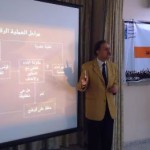
The discussion inside the workshop was run by Ali Barghout, lecturer at Al-Aqsa University, who set out the strands to be discussed at the start of the meeting, which contributed to creating a civilised dialogue among those present, who asked about the role of civil society organisations, intellectuals and business people in contributing to pressing the authority to end the state of division and to move quickly towards a community reconciliation.
Those present called for the need to separate the reconciliation file from the rest of the other political files that obstruct its achievement, in addition to reactivating the role of the community reconciliation committee so that there may be better results on the ground, and so that this bad incidental state, which has exhausted society and almost diverted its course, may be ended.
The great political changes our Palestinian people are living through require the existence of an aware social structure that presses on the political elites, organises political interactions and is receptive to the democratic transition the homeland may witness thereafter. We must kill the policy of monopoly, for the homeland is not for this one or that one; the homeland is for all Palestinians, the Palestinian cause concerns us all, and the Israeli bullet kills everything that is Palestinian