Speedy trials and their effect on easing overcrowding among inmates in reform and rehabilitation centres
Gaza, Publication and Information Unit
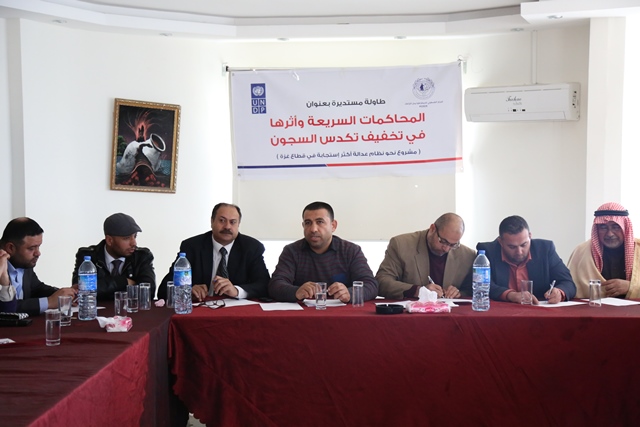
On Monday the Palestinian Center for Democracy and Conflict Resolution, in partnership with the United Nations Development Programme (UNDP), held a workshop entitled "Speedy trials and their effect on easing overcrowding among inmates" in the hall of the Adam Hotel, as part of the activities of the project "Towards a more responsive justice system in the Gaza Strip". It was attended by Dr. Majed Shaaban, deputy attorney general, Mr. Hassan Al-Hissi, judge of the court of first instance, Lieutenant Colonel Sameh Hamdan, director of the reform and rehabilitation centre, and, from the Palestinian Center for Democracy and Conflict Resolution, the director of the Centre Mr. Iyad Abu Hjair and the head of the legal unit Mr. Younis Al-Tahrawi, as well as a number of mukhtars, lawyers and members of the Palestinian police.
Gaza, Publication and Information Unit
On Monday the Palestinian Center for Democracy and Conflict Resolution, in partnership with the United Nations Development Programme (UNDP), held a workshop entitled "Speedy trials and their effect on easing overcrowding among inmates" in the hall of the Adam Hotel, as part of the activities of the project "Towards a more responsive justice system in the Gaza Strip". It was attended by Dr. Majed Shaaban, deputy attorney general, Mr. Hassan Al-Hissi, judge of the court of first instance, Lieutenant Colonel Sameh Hamdan, director of the reform and rehabilitation centre, and, from the Palestinian Center for Democracy and Conflict Resolution, the director of the Centre Mr. Iyad Abu Hjair and the head of the legal unit Mr. Younis Al-Tahrawi, as well as a number of mukhtars, lawyers and members of the Palestinian police.
For his part, Lieutenant Colonel Sameh Hamdan praised the existence of speedy trials, which serve to ease the burden on the prisons and the overcrowding they suffer from, but said that they have not reached the goal sought, because a prisoner is held for a long period, which is not lawful, and that the lock-ups, as he described them, are not fit for human beings and represent a violation of their rights.
Mr. Hassan Al-Hissi, judge of the court of first instance, thanked the Conflict Resolution Center for its interest in this important question and for taking it up. He explained that the overcrowding problem is a material rather than a technical one, and that it is due first and foremost to the Israeli occupation, which continually bombs and destroys police stations and prisons, and that despite this the judiciary is making continual efforts to help provide decent places for prisoners.
Mr. Iyad Abu Hjair said that although the overcrowding problem is material and economic, police officers should be given greater powers to release some of those involved in minor matters. He pointed to the role and involvement of the mukhtars in easing overcrowding among prisoners by intervening and finding solutions before cases are referred to the judiciary.
In an address on behalf of the mukhtars, Mukhtar Saif Abu Ramadan said that a committee had been formed with the attorney general to look into speedy trials in murder cases, while Mukhtar Nader Al-Masri added that Islam has its prescribed penalties and had no prisons, and that applying the prescribed penalty to the wrongdoer is better than imprisoning him.