
The Ministry of Public Works rejects the Serry plan for rebuilding Gaza
Gaza, Publication and Information Unit
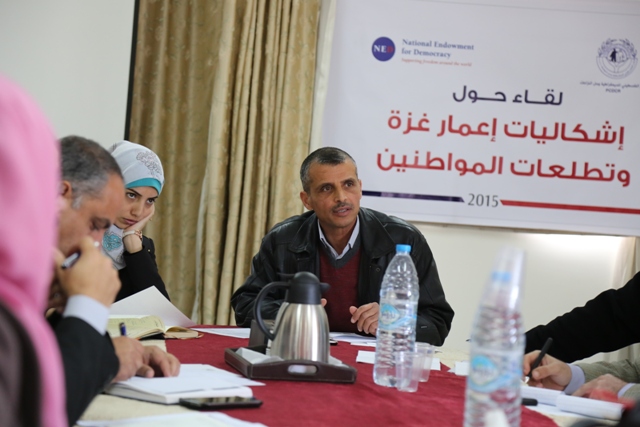
The Ministry of Public Works and Housing rejected the Serry plan for rebuilding Gaza and called on citizens to press for it to be suspended, in order to speed up the reconstruction process. This came during a meeting held on Wednesday by the Palestinian Center for Democracy and Conflict Resolution entitled "The difficulties of rebuilding Gaza and citizens' expectations", seven months after the war on Gaza, with the participation of figures directly connected to the reconstruction file.
Eng. Naji Sarhan, deputy minister of public works and housing, pointed out that during the war the ministry worked to survey the damage in cooperation with the bodies concerned, such as UNRWA and UNDP, and that this work continued after the war, with roles divided among them and a unified survey mechanism agreed. He said the number of those affected reached 132,000 with partial or total damage, and 12,000 housing units totally destroyed.
He added that the aid received had been distributed to those affected in the form of caravans, until the number of caravans became very large, which led the ministry to refuse to keep receiving them for fear that it would stray from its relief role and that future planning would not serve the interests of the affected citizen. He also raised the question of rent allowances, noting that UNRWA provided a rent allowance to 9,000 cases for four months and that the United Nations Development Programme UNDP provided a rent allowance to 2,000 families, while there are 3,300 cases that also need a rent allowance.
Sarhan explained that more than one body has provided grants to the Palestinian people, among them Qatar, Saudi Arabia, Kuwait and the Islamic Bank, but that the problem lies in the entry of building materials: the total that has entered is 35,000 tonnes of cement, because of the severe control mechanisms that tighten the grip on building materials entering the Strip. He added that the ministry rejects the Serry plan because it obstructs the rebuilding of Gaza, since reconstruction requires all the crossings to be opened, and the plan does not meet the minimum needed for reconstruction.
For his part, the representative of the United Nations Development Programme, Eng. Hikmat Al-Khairi, stressed that the organisation works in coordination with the ministry in following up the figures and auditing the cases surveyed so that there is no duplication. He said the number of damaged units reached 31,156, divided between total damage, partial damage and uninhabitable, explaining that what the Gaza Strip needs for reconstruction amounts to 200 million dollars, of which only a little has reached us. He also said that 4,300 families need a rent allowance amounting to 32 million dollars, that 2,620 families have been provided with a rent allowance for four to six months, and that 1,210 families will be provided with it at the start of next week.
Mr. Iyad Abu Hammam, representing the Norwegian Refugee Council and coordinator of the shelter programme, added that we must work to unify the criteria for assessing damage between the bodies concerned and to unify the pattern of assistance, such as the rent allowance. He said the shelter programme set the minimum specifications required in the caravans provided to the Palestinian people, and that it also follows the building materials entering through the crossings and what has been used of them, and provides the necessary interventions and relief to displaced people during storms and rain. Mr. Abu Hammam called for following up the funds provided to citizens as rent allowance, on what they were spent and where.
Mr. Osama Al-Saadawi stressed that there is an urgent need to provide specialised engineers to address the difficult technical problems in houses, which could bring them down in any future accident, and that the most significant problems raised are the question of licences at the municipalities and disputes with families over the boundaries of their homes.
Dr. Jawad Al-Agha, adviser to the Ministry of Public Works, said that all the members of the associations and popular committees must unite and come together so as to form a single body that conveys the problems and the suffering directly to the ministry, and that a mechanism of communication between them should be coordinated. As for household furniture, Al-Agha explained that the ministry has prepared a reconstruction manual and that through it the ministry has raised the price per square metre to cover furniture for destroyed homes.
The displaced persons' association stressed that there are problems facing displaced citizens, such as delays in paying rent, and that there are problems in managing funds and in the haphazard distribution of the quantities of cement disbursed to people, which has deprived citizens in need of their right and given it to those not in need.
Eng. Naji Sarhan responded that there were some mistaken cases during the damage survey because of the vast number of citizens in need, that the matter was addressed with UNOPS, and that this was also due to the obstacles the Israeli authorities place on the entry of materials and aid.
Abdel Moneim Al-Tahrawi, projects director at the Palestinian Center for Democracy and Conflict Resolution, added that there is a failure in access to information and that we need to obtain sufficient information on the reconstruction file and on all the obstacles impeding it, through the use of media platforms.


