A call to form a preparatory committee ahead of discussing the provisions on separation in the personal status law
Gaza, Publication and Information Unit
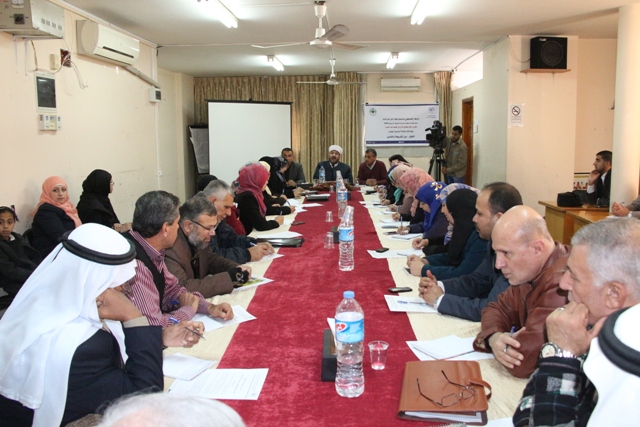
The Palestinian Center for Democracy and Conflict Resolution, in partnership with the Norwegian People's Aid (NPA) office, held a round table entitled "Khul': between sharia and the law", within the project "Towards a society free of violence against women".
The meeting was attended by Dr. Hassan Al-Joujou, president of the Supreme Council of Sharia Judiciary, Dr. Nafez Al-Madhoun representing the Legislative Council, and a number of representatives of human rights centres, lawyers and some reconciliation figures.
Mr. Younis Al-Tahrawi, head of the legal unit at the Palestinian Center for Democracy and Conflict Resolution, opened the meeting by welcoming those present. Dr. Al-Joujou then spoke about the concern Islam shows for women and their standing, and pointed to the need to lift the injustice done to women in general and to women left in marital limbo in particular. He stressed that it is a wrong for which society as a whole bears responsibility and for which a swift and urgent solution must be found, and then reviewed the articles of the draft khul' law for those present.
In the same vein, Dr. Nafez Al-Madhoun stressed that pressure must be put on the members of the Legislative Council to hold an emergency meeting on the draft khul' law, and that we must overcome the political obstacles and consequences present on the Palestinian scene as a result of the internal division. He pointed out that the Legislative Council had three approaches to this draft: the first, amending some articles of the personal status law; the second, drawing up a new personal status law; and the third and last, enacting an independent law for khul'. He added that it is essential to amend some of the articles proposed in the draft khul' law submitted by the High Council of Sharia Judiciary.
For his part, sharia lawyer Sheikh Imad Hamtu said that a large number of women suffer from being left in marital limbo, and that there should be great efforts to amend some of the legal articles relating to desertion and limbo in order to make procedures easier for the women who suffer from this.
The meeting included many interventions from those present as well as a number of questions put to the guests. At the end of the meeting there were many recommendations, foremost among them that a preparatory committee be formed to prepare for a full study day on how to arrive at facilities relating to the question of marital limbo and the articles concerning this subject. The Palestinian Center welcomed these recommendations and will work next month on some of them in coordination with all the partners.