Women community activists break into the field of reconciliation in the Gaza Strip
Gaza, Publication and Information Unit:
Women community activists have broken into the field of reconciliation, family intervention and reducing violence against women in the Gaza Strip, in an encounter between the activists and the reconciliation figures (the mukhtars), amid differing views and reactions about the nature of women's work in supporting women subjected to violence on the one hand, and the mukhtars' acceptance of women's work on the other.
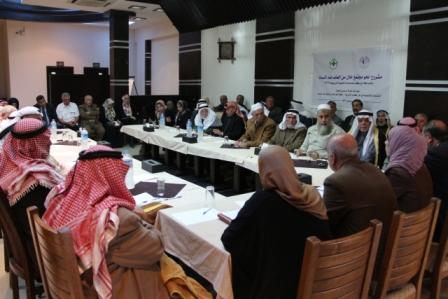
In this connection, the Palestinian Center for Democracy and Conflict Resolution held the first round table meeting today, entitled "Women community activists in resolving cases: a step towards reducing violence against women", at the Carinos restaurant in Gaza City, with the participation of 70 reconciliation figures, women community activists and representatives of civil society from all the governorates of the Strip.
In this context, the projects director at the Palestinian Center for Conflict Resolution, Abdel Moneim Al-Tahrawi, stressed that the Centre's philosophy in establishing women's reconciliation committees springs from its vision of equality between men and women in fields of work: community work is not confined to men, and the Centre has achieved clear successes by women within society. He said: "Today's encounter between women community activists and reconciliation figures is intended to bridge the gap and bring the two sides' views closer together in support of women, and to arrive at an agreement that women community activists have become a social and institutional necessity for intervening in cases men may be unable to intervene in, given the particular nature of our society."
For his part, the social worker at the Palestinian Center for Conflict Resolution, Samir Al-Muqadama, stressed that the Centre is working to prepare a body of women community activists according to professional standards and to educate them so that they can support reconciliation figures in resolving the problems and crises arising from disputes within households. He expressed his confidence in the success of the women community activists in performing their tasks and in overcoming the difficulties some mukhtars place before them, and in the earnest effort to support these women mukhtars in helping women who are victims of violence.
For his part, Dr. Nemat Alwan, professor of psychology at Al-Aqsa University, said that the physiological, emotional and rational make-up differs between men and women, since the flow of blood in the human brain goes towards the emotional part more than the rational part, which raises concern about emotional influence on women's decisions. He pointed out that a woman's principal role is in her home in raising children alongside her household work, rather than being tied to work outside the family, although women have energies and capacities of endurance many times those of men.
For her part, the woman mukhtar Faten Harb, a community activist, stressed the need for women to work alongside men in resolving family disputes, since a woman has the ability to learn the truth of the problems facing women who are too embarrassed to disclose the details of these problems before reconciliation figures. She added: "Women mukhtars are the best placed to diagnose problems, define them and find solutions, and despite the fronts of refusal we face from some mukhtars, we will carry on with our role in order to help reduce violence against women subjected to it."
In the interventions by participants and those present, the chair of the board of the Wifaq Association, Buthaina Sobh, pointed to the need to define the roles played by the woman community activist so as to ensure there is no conflict with the role of reconciliation figures. She called on the women mukhtars to work on balancing their household and professional commitments, as well as on preparing specific places for the work of women community activists, separate from the places where reconciliation figures work.
Mukhtar Mohammed Al-Dardouni opposed a woman leaving her home and her household responsibility, saying that she should go out only for important reasons such as work in education and health to assist men in schools and hospitals, saying: "A woman must know that the real role in resolving community problems falls on men and not on women, according to custom and tradition."
For his part, Mukhtar Salim Salah explained that women can carry out all the roles they were made for, whether inside or outside the home, and that we see successful examples of women within our society: the judge, the engineer and the lawyer. He called on his fellow reconciliation figures to accept women community activists entering the arena of community work and supporting the resolution of family crises and problems.