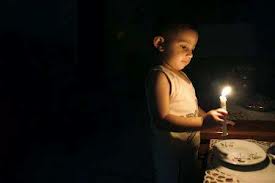
The effect of power cuts on the Gaza Strip
By the technical supervisor Shireen Al-Bayari
The electricity problem is distinctive in that it imposes itself on people's thinking and defies being forgotten, not only because it is a daily problem but because it affects everything: homes, hospitals, health centres, water, sewage and all the essential services, and it affects most groups in society.
1. On the psychological and social situation of the citizen:
It is noticeable that power cuts have caused many problems between neighbours because of the disturbing generators that give off foul smells along with a disturbing noise. Such problems have even extended to arise between brothers and cousins.
Also, through work in the field and the wide presence of the Palestinian Center for Democracy and Conflict Resolution, an increase has been observed in cases of divorce and marital separation, which is also among the accumulated negative psychological effects of power cuts.
There are also several behavioural disorders, psychological disorders, sleep disorders and eating disorders that have appeared in children as a result of the incidents that occurred after power cuts at night, with several children dying and others suffering multiple burns caused by generators exploding and by an entire home burning down as a result of a candle lit inside the house during a power cut at night. On the other hand, we should not forget the cases of suffocation from heating with charcoal in winter. Alongside this, social visits and family ties between relatives have declined.
2. On the environment and livestock and fish resources:
Power cuts and fuel shortages threaten an environmental disaster if the four treatment plants stop, plants whose capacity is already small compared with the quantities of wastewater reaching them. The continuation of the crisis may also lead to the wastewater pumping stations stopping, which means it would overflow into the streets, with countless health hazards, in addition to contaminating the aquifer.
The serious consequences of power cuts have affected the right to obtain safe and sufficient food, since these cuts have affected poultry, livestock and fish resources, with harmful effects at the stages of rearing, production and consumption, which is seriously reflected in food security.
3. On education:
Power cuts have affected the education sector: these cuts are reflected negatively in the education sector and its enlightening, developmental mission, affecting the proper and best conduct of the educational process inside schools and in the higher education institutions that rely on the open learning system.
4. On the economy:
Power cuts increase the suffering of the Strip's residents, who face extremely difficult economic and social conditions. Power cuts, the shortage of the fuel that runs the generators and its high prices cause factories heavy losses: power cuts have raised the cost of production, reduced factories' productive capacity and spoiled many products, particularly in the food industries, in addition to the costs of maintaining machines, equipment and electronic devices as a result of repeated breakdowns and the irregularity of the electricity supply. To this are added the financial burdens borne by shop owners from buying diesel and maintaining generators.
5. On the citizen's economic situation:
Power cuts have also raised the daily cost of living for the Strip's families, with the price of candles and alternative sources of lighting and of buying diesel of various kinds and petrol, which increases the suffering of citizens living in extremely difficult economic and social conditions. To this is added the stopping of household refrigerators because of the power cuts, which causes stored food to spoil in general and meat, dairy products and fish in particular, and these may become a principal carrier of the bacteria that cause diarrhoea and food poisoning among children, particularly as their rates are also expected to rise because of water and food contamination.
Alongside this are the breakdowns that occur in electrical appliances as a result of repeated and unscheduled power cuts, and the costs of maintaining those appliances as a result of the irregular supply.
6. On the health situation:
There are many illnesses affecting children and adults because of the intense heat, and as we see, the electricity supply does not extend beyond 8 hours in 24. Among the illnesses affecting children is "skin allergy, which causes itching in children and an inability to sleep from the pain"
Alongside this, failing to deal with the intense heat leads to raised blood pressure in patients and raised blood sugar in diabetics.
There are many cases daily undergoing surgical operations of all kinds, and those cases need the temperature at home to be reasonably moderate so as to help the healing process and avoid complications after surgery. That requires electricity to run fans or air conditioners.
Alongside this there are illnesses that react to heat, such as rheumatoid arthritis and rheumatism, which elderly people in Gaza suffer from, and many other illnesses.
We therefore hope that the two governments in Gaza and Ramallah will ensure that the service sectors are kept clear of political tugs of war and conflicts, including the electricity supply service, and that dealings with it are confined to a professional and technical framework, in order to help find solutions to the problems connected with it and to ease citizens' suffering.