Khan Younis, Publication and Information Unit:
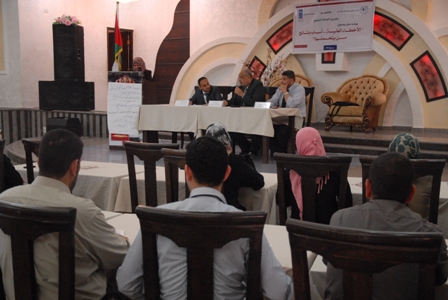
The Justice for All project at the Palestinian Center for Democracy and Conflict Resolution held a workshop entitled "Medical errors: causes, consequences and who bears them", within its strategy of engaging with community and local issues. The workshop was organised at the Happy Palace Hotel in Khan Younis governorate with the participation of 50 people representing organisations, universities and reconciliation figures in the south.
At the start of the meeting, the member of the Legislative Council Dr. Khamis Al-Najjar stressed that medical errors are a problem that has existed since ancient times and that their effects and consequences differ from one country to another, with Palestinian society affected by medical errors from time to time. He added: "The Gaza Strip has suffered under siege for four years, and the Ministry of Health follows up the complaints received from citizens regarding any medical errors, and the doctors at fault are held to account if charges of negligence against them are established."
Al-Najjar explained that the foreign delegations visiting Gaza bring a number of medicines, most of them close to their expiry date, or bring types of medicine that are not needed, in addition to bringing medical devices that are difficult to operate and for which there are no repairs or spare parts in Gaza. He pointed out that Palestinian law must punish everyone at fault, whether doctors or patients, because some patients stir up citizens against doctors, and so the law must provide a solution to the creation of confusion within society.
For his part, Dr. Youssef Awadallah, director of the Rafah psychiatric clinic, explained that medical errors help increase the health and psychological risks to patients, which is reflected negatively in their health in the future on the one hand and in their fear of receiving treatment and loss of trust in doctors on the other. He called for the need to educate citizens about medical conditions in the Palestinian territories and to bring views closer together with the medical team of doctors and nurses in order to ensure a safe environment for all citizens.
For his part, the assistant coordinator of the Justice for All project, lawyer Anwar Azzam, spoke about the need to enact a law transferring responsibility for a medical error caused by a doctor to their personal responsibility, and to work on forming a supervisory body of experts and advisers at the Ministry of Health to follow up health conditions inside the hospitals. He said: "We believe the ministry should organise educational courses for doctors to keep pace with modern medicine, diseases and medical devices, and that social organisations should be keen to take up the cases of those who are victims of medical errors and support them."
Those present recommended the need to apply electronic medical records for patients in order to follow their health conditions over the internet, so that a patient is not diagnosed more than once at several hospitals and clinics; to press for the licence to practise to be withdrawn for a set period from any doctor in breach; to work on establishing oversight by the specialised associations and organisations over medicine prices; and at the same time for the Ministry of Health to provide material and psychological compensation to the victims of medical errors and to seek to increase citizens' medical awareness of how to deal with medical teams.
It is worth noting that the Justice for All project, in partnership with the United Nations Development Programme (UNDP), will organise further workshops with the Palestinian public in the coming days on a number of local issues and problems in the Gaza governorates.