A workshop entitled: the media and its role in strengthening civil peace
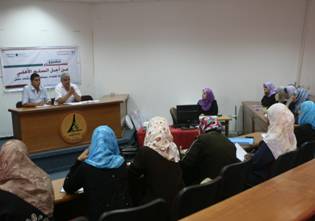
As a continuation of the series of workshops and meetings organised by the Palestinian Center for Democracy and Conflict Resolution within the project "Women for civil peace", the Centre organised a workshop at Al-Aqsa University entitled "The media and its role in strengthening the concept of civil peace". The workshop's guests were Dr. Talat Issa, head of the journalism and media department at the Islamic University, and Dr. Nabil Al-Tahrawi, lecturer at the media faculty of Al-Aqsa University, in the presence of 30 female students from Al-Aqsa University and the Islamic University. The workshop was run by Shaimaa Miqdad, member of the student leadership team affiliated to the project, who introduced the Palestinian Center for Democracy and Conflict Resolution and gave an outline of the Centre's most important achievements over the past three years in the framework of the call to end the division between the two halves of the homeland. The guests discussed several strands during the workshop, beginning with Dr. Talat Issa focusing on the importance of the awareness and culture spread by such workshops, whose subjects address concepts specific and necessary to the development of Palestinian society and to rejecting the elements of division and disagreement between brothers. Dr. Issa also stressed the role the media must play in strengthening these concepts and spreading them, rather than playing the opposite role by entrenching wrong concepts that call for widening the gulf between the disputing parties. He called for the existence of oversight of the content of the media message broadcast to the hearing and sight of the Palestinian citizen, and called on the citizen to verify the news that may touch the national interest and not to publish and spread it without distinguishing the dangerous aims such news seeks. Dr. Nabil Al-Tahrawi noted that the roots of the crisis in Palestine are a crisis of values and morals before being political, whose dangerous expressions were reflected in giving precedence to the internal opposition among the ranks of society over the basic contradiction, which is the occupation, and in excluding dialogue to resolve this opposition, which led to the use of armed violence and to journalistic work and journalists being subjected to violations in the West Bank and the Strip, which led the Palestinian media out of its natural context and its aims and professional and ethical rules. The workshop stressed the need to activate the work, moves and activities with those running the media and with the journalists themselves, and to oblige them, through mass activities, qualitative events and distinguished work, to deal with media messages within a cumulative process that must produce the required effect on the decision-making process. It is worth noting that Al-Muntada satellite channel covered this workshop and conducted several interviews with the guests, with the female students present, with the project coordinator and with the staff of the public relations department at Al-Aqsa University about the importance of carrying out such workshops inside Palestinian universities and their role in spreading the concepts of civil peace among the members of Palestinian society.