
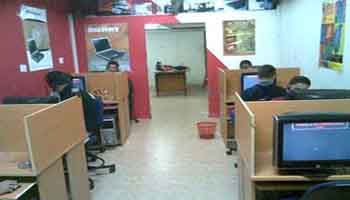
The phenomenon of dropping out of school and children turning to internet cafés and games
Prepared by the psychological counsellor Shireen Al-Bayari. Dozens of pupils are still lost between carrying on and resorting to the internet games clubs, which are filled daily with these pupils away from the eye of family and school supervision, amusing themselves and loitering, unaware of their fate. The question that arises is: is there any way to help these pupils before it is too late, and what is the role of the competent bodies supposed to care for and protect them, and what are their responsibilities towards this phenomenon when they pass by the internet shops and other places that may be a breeding ground for deviation and that in the end bring them to ruin and deprive them of being a cultured, productive generation in society? Video game shops have emerged recently as a destination for those dropping out of school and as an additional and encouraging reason driving them to drop out. Looking at the ages of those frequenting these shops, we find that they range from primary to secondary school age, and so it is a phenomenon widespread across the various school stages. Those who have dropped out frequent these shops during school hours and outside them. As for the nature of what these shops offer and what they are, they are generally and simply shops equipped with a network of several computers through which users can play a game collectively, each on the machine he is sitting at. Instead of the old games consoles, the use of computers allows and makes it easy for the owner of the games café to change and renew the games constantly, which helps prevent boredom creeping in among the users and keeps them coming back to the café. Games cafés are widespread in places close to schools, which makes it easy for those dropping out to reach them. As a place of amusement and entertainment based on active engagement that stirs enthusiasm among the users, it is for those dropping out better than the school, whose daily programme lacks anything of the sort, with its dry, theoretical lessons and a teaching style barren of any means of attraction or tools that stir interest and engagement. Reasons for the spread of games cafés: the well-known games cafés are not a phenomenon born in the last period and months, for they have existed for several years, but their intense and wide spread is what is new, and this spread has many causes: The availability of home internet made the patrons of internet cafés turn away from them, since they became able to connect to the global network from their homes, and in search of new customers the owners of those cafés decided to turn them into games cafés. Opening a games café requires means that are not modest, but recent circumstances and the entry of goods and equipment into the Strip through agreement at low prices compared with previous prices removed this problem and made it easier to provide the equipment needed to open a games café project. As a result of the current circumstances and the stagnation of the job market, a number of graduates of computer-related specialisations have found these projects one of the few options available to them to break the unemployment they suffer, although they are far from their field of specialisation. On the other hand these cafés, since they rely on the computer, have provided those who failed or were expelled from computer-related faculties and specialisations with a cover for their failure behind which they hide from facing themselves and the society around them, since it is an easy occupation compared with maintenance and programming shops, of which they understand nothing. Parents' belief that these cafés develop their children's abilities in dealing with the computer, and making it a project that brings its owners excellent profit without exerting hard efforts to obtain it. Some of the harms arising from this phenomenon: Since the patrons of these shops are school pupils and since it is a phenomenon that causes them to drop out, it does no small harm to the educational progress of those frequenting those shops and weakens their academic attainment. Children play inside these cafés as a paid service, and this causes them to direct their daily pocket money to this end instead of spending it on a school pupil's natural needs. Some children may resort to using impermissible means to obtain the money needed if they are unable to obtain it, such as stealing from a parent's pocket, and thus acquire bad traits. Children waste long hours inside these cafés and some become attached to the point of addiction, and this works to keep them away from social contact with their families. Sudden circumstances and changes such as power cuts may cause depression in those addicted to these cafés, since they deprive them of practising their favourite pastime. Some parents forbid their children from entering these cafés, and so school hours become the time available to do so away from the parent's supervision, and dropping out of school becomes necessary to fulfil the wish. Most of the games available in the cafés are war games whose idea revolves around killing rivals in order to win the game, and this leads to developing a tendency to violence in them, and this violence may come out against their classmates at school and elsewhere. Often there are users of different age groups inside the café, and it happens that users utter crude and vulgar words while playing, and the young ones may learn them and they spread among them. Recommendations: The need for continuous communication by parents with the school. The need for supervision by the competent governmental bodies and continuous oversight of the cafés. The need to activate extracurricular activities at schools to entertain the child and provide an alternative to the cafés.


