
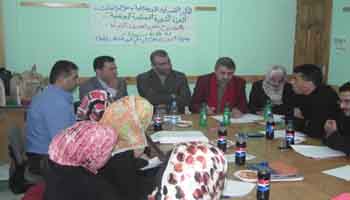
The Centre calls for the independence of the media in support of national reconciliation
In the presence of a large number of media professionals and academics, the Palestinian Center for Democracy and Conflict Resolution and the popular campaign for community reconciliation, in cooperation with the Southern Women Journalists' Forum, organised a round-table meeting at the Centre's premises in the city of Khan Younis on the media's role in supporting national reconciliation efforts, during which the question of the media was addressed from a professional point of view. Fathi Sabbah, correspondent of the London-based Al-Hayat newspaper, called in his intervention for the media to play a positive role and contribute to creating unity and national consensus rather than a destructive role, pointing to some media outlets that had played a dangerous role in entrenching the division. Sabbah gave a historical overview of the development of the Palestinian media movement and how it played a pioneering role in the people's unity in facing and resisting the policy of the Israeli occupation. The academic Imad Mohsen confirmed that the media outlets and some satellite channels had succeeded at some stages in entrenching the division, far from the professional and national role they are supposed to play in serving citizens' interests and calling for national unity; and also the use of accusations of treachery, which contributed to deepening the state of division the Palestinian street is going through. For his part, Abdel Moneim Al-Tahrawi, coordinator of the popular campaign for national reconciliation, gave an explanation of the popular campaign for national reconciliation launched by the Palestinian Center in 2007 and of the reconciliation document, which addressed several files and helped bring the viewpoints of the parties to the conflict closer. He laid responsibility on the Palestinian and Arab media for playing a destructive role towards the reconciliation process, and called on press and media professionals to be marked by independence in support of reconciliation efforts. For his part, the journalist Salah Abu Salah called for the media not to be a tool in the hands of the parties so that they do not extend their dominance over it, and valued the Palestinian Center's efforts in taking on part of the initiative towards the reconciliation process. The community activist Abd Rabbo Abu Teim called for the independence of the media and for keeping away from methods of accusing others of treachery and stirring party rivalries, which only increase our society's division and disintegration. For his part, the correspondent of Sawt Al-Quds, Muthanna Al-Najjar, called for a law to regulate the media situation so that every media professional who deviates from his professional and national role in uniting the word and opinion may be held to account, and also for creating a state of awareness directed at media professionals so that they are not dragged along by all the calls that deepen the Palestinian division. Samir Al-Muqadama pointed to the need to form a media body that presses the two parties to the conflict to submit to the wish of citizens who aspire to a national reconciliation that restores their standing, and Osama Khreis repeated the call to adopt a media campaign to exert pressure towards making national reconciliation succeed. The correspondent of Bethlehem 2000 Radio called for unifying the local media discourse and for the journalist to be marked by balance in reporting the news so as not to contribute to inflaming the situation, and to be shunned if he plays such a role. At the end of the meeting the floor was opened for discussion and those present produced several recommendations, the most important of them: • Boycotting journalists who are not marked by unifying orientations. • The need for Palestinian media professionals to hold to the ethics of the profession. • Forming a media body that supports journalists who support the concepts of national unity in the service of the reconciliation process. • The media professional and the politician are partners in strengthening the principles of national unity, and their roles must be complementary rather than one working as a party to the other.


