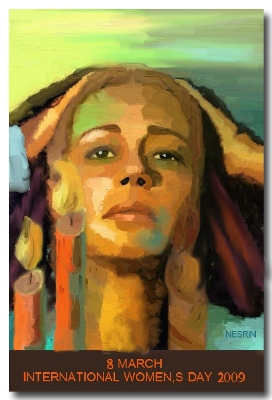
One day for women
One day is given to women to search through Adam's archive for their rights. A day on which Adam remembers the rights of the source of his inspiration, his starting point and the destination of his aim and his dreams. The Western media throw everything they have into an international day on which they enrich women's rights and stir the stagnant waters, and then follow waves and consequences of Arab media reactions, and perhaps promotional ones, about an annual preamble called women's rights.
Do we remember her rights only on this day? Or is every day a right for women? Can Adam forget her the rest of the days?
Be quiet, Adam, we want no answer from you. But can you do without her for a moment? We are besieged by her, bound and shackled by her order. So every day is for women and all the time is hers, to make happiness for us, the sons of Adam, in the mould of life.
Some are mistaken when they compare the Western agenda of women's rights with the Arab one, for the single dot that separates the two words has done a great deal, since her rights differ in size and weight according to her geographical location, the laws of her country and its traditions and customs.
When some people speak of certain women's rights they are accused of libertinism and secularism, as happened to me and to others, and this is only natural in the face of the traditional and reactionary man, with respect for his view. The strange thing is that many imagine that advocates of women's rights want to push her into the corridors of dissolution and licentiousness. Do we really want to strip off her cloak and smear her with the colours of make-up, merely by her driving a car or working in the fields of life alongside her own kind?
Adam said: you are a woman, and you were created, in the Darwinian manner, from a crooked rib, so you are an endowment to us, the company of men. You eat what is left of our food and enjoy what remains of our comfort. Stand in the back row, or shall I say to you: get out of my sight and keep to yourself in worship, as the noble verse indicated, so that you may stay and remain within your house. You are a pleasure for us, the sons of Adam, so wrap yourself in black and place yourself on the dish of a man's happiness.
She said: but Adam, heaven gave me the right to share with you in most fields. Look at our ancestors, my partner! This is a duty laid down and not something composed from your own store. I do not want rights, only restore what the first woman obtained. He answered her: no work for women, no participation for women, no education for women, no civil or administrative standing for women, no share of participation in society. Only a file at the nearest hospital for your treatment, and I will call you my mother, my wife, my sister and my daughter until we put you in the grave.
Yes, madam, you are from and to the age of darkness, and what you were told about Islam and its noble laws, which it placed at the service of women and by which it gave her a share in partnership with man in the nerve of life, is lie upon lie, or perhaps rumours that fell inadvertently from the pens of historians and orientalists.
True, we heard that Arab women at the dawn of Islam treated and tended the wounded, contended with men in poetry and prose in the market of Ukaz and before the sultans, worked alongside men on the land and at sea, and competed with men in trade, perhaps outdoing them in some arenas. But I repeat the record for you: it is charlatanry and superstition and does not accord with the principle of Adam's laws today.
But my mind is bewildered and I want the answer: how can Adam refuse to let Eve work in the fields of life, and then, when he wants a service for women, stipulate the presence of a woman? Shall we conjure one up out of nothing, or is it better to answer him with a kick?
Fawzi Sadeq, novelist and writer