The Centre organises the conference "National reconciliation efforts: successes and failures"
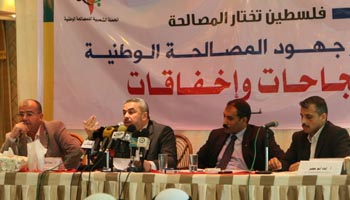
Gaza, 3/2/2010: the Palestinian Center for Democracy and Conflict Resolution and the popular campaign for national reconciliation this morning organised a special conference on "National reconciliation efforts: successes and failures", attended by a large number of political, parliamentary and independent academic figures and a large gathering of notables, mukhtars, women, young people and citizens. The conference opened with fragrant verses from the noble Qur'an and then the Palestinian national anthem. The first session began with the presentation of a filmed report on the activities and events of the popular campaign for national reconciliation, and then Mr. Iyad Abu Hjair opened the first session, entitled "National reconciliation efforts and the obstacles to achieving them", offering thanks to everyone who took part in and contributed to making national reconciliation succeed, and introducing Dr. Salah Abu Khatla, a leader in the Fatah movement, with a working paper on "The reality and prospects of national reconciliation from Fatah's point of view". For his part, Dr. Salah set out the movement's position on reconciliation, stressing that Fatah's hearts are open to national reconciliation. Dr. Ismail Radwan, a leader in the Hamas movement, then presented a working paper entitled "The reality and prospects of national reconciliation from the point of view of the Hamas movement", stressing that national reconciliation is the strategic choice, and that it is not an aim but the means to end the division. Mr. Saeed Al-Muqadama, director general of the Centre, presented a working paper entitled "The reality of national reconciliation from the point of view of the civil organisations", in which he set out the reality of reconciliation today and what we are striving for, stressing the need to respect the people's wish for reconciliation, since it is a popular demand, and the need to open the door to dialogue between the young leaderships in both movements and not to confine it to the senior leaderships. He also praised the role of the civil organisations despite the poor coordination and the harassment practised by the two movements. The second session, entitled "Proposals to support national reconciliation efforts", was chaired by Mohammed Abu Al-Kheir, and included a number of different working papers. The session began with a working paper on the role of the national factions in making national reconciliation efforts succeed, presented by Mr. Kayed Al-Ghoul, a leader in the Popular Front. Mr. Kayed Al-Ghoul confirmed: "The role of the national forces is important and great, and the national interest must be given precedence over private interest, and the work of the national forces must be integrated with the interests of the people and the homeland." Mr. Nafez Azzam, a leader in the Islamic Jihad movement, then presented a working paper entitled "The Islamic Jihad movement: proposals for emerging from the crisis of division", setting out in it that national unity is the foundation and that the crisis cannot be resolved without serious work on the divergence of political programmes and a return to the people once again. The political analyst Talal Awkal presented "A reading of the Egyptian paper for national reconciliation", setting out the need to make use of the time and to sign the Egyptian paper with guarantees ensuring its proper implementation on the ground. The conference produced a set of recommendations, the most notable of them: 1. Raising the level of the media and public discourse of the disputing parties in a way that strengthens reconciliation efforts and is free of tension on the scene. 2. Those present stressed the need to hold to the historic constants. 3. The need to halt political arrests completely by both sides. 4. National dialogue must take place among all the factions and not bilaterally. 5. Halting the encroachments on the union institutions and civil society organisations. 6. Elections are a popular demand and must not be postponed, for they are one of the citizen's rights. For his part, Abdel Moneim Al-Tahrawi, coordinator of the popular campaign for national reconciliation, confirmed that these efforts come as a continuation of a long journey of pressure on the parties to the conflict with the aim of bringing viewpoints closer and working to give precedence to the general interest and to the interest of the Palestinian people. He added that the conference's recommendations will be taken into account and that the Centre is about to launch a new campaign among the campaigns supporting national reconciliation efforts in the coming days, aimed at increasing work with the parties to the conflict in order to achieve reconciliation.