Fatah and Hamas show flexibility in handling the agreement's clauses in order to complete national reconciliation
Gaza, Publication and Information Unit:
Both the Fatah and Hamas movements showed flexibility in handling the clauses of the agreement between them in order to achieve national reconciliation between the two parts of the homeland in the West Bank and the Gaza Strip, and to work on ending all the current disputes between the two sides as quickly as possible so as to ensure that security and tolerance are rooted within Palestinian society.
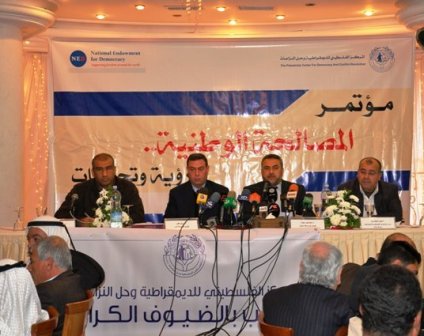
These statements came during the conference held by the Palestinian Center for Democracy and Conflict Resolution entitled "National reconciliation: vision and challenges", with the participation of representatives of the Fatah and Hamas movements and the Palestinian factions, at the Grand Palace Hotel in Gaza City, attended by representatives of the government and a number of human rights and national organisations, reconciliation figures and mukhtars.
For his part, the director general of the Conflict Resolution Center, Saeed Al-Muqadama, pointed out that the Palestinian situation is difficult and fragmented because of the fighting and continuing conflict between Fatah and Hamas over five years. He explained that the Palestinian people need these disputes settled as quickly as possible by applying the clauses of the reconciliation agreement signed on the fourth of May last year under the auspices of our Egyptian brothers.
In an address on behalf of the Fatah Movement, the Fatah leader Diab Al-Louh stressed that his movement has regarded the division as a secondary contradiction, on the basis that the principal contradiction is with the occupation. He considered that using peaceful means to resolve contradictions, such as constructive national dialogue and a high sense of national responsibility, are among the most important tools of pressure for protecting the achievements of national reconciliation.
Al-Louh reminded the factions that his movement holds to the Palestinian national accord agreement signed in Cairo last year, given Fatah's confidence that ending the division comes about through peaceful means by building bridges of trust and strengthening political participation. He stressed that reconciliation is actually achieved by forming the Palestinian government and holding presidential and legislative elections, in addition to achieving community reconciliation and developing the Palestinian security staff under a unified national and professional framework.
In an address on behalf of the Hamas Movement, Dr. Ismail Radwan said: "Hamas holds to reconciliation as a strategic choice for the Palestinian people and a step from which there is no going back, despite the slowness in carrying out the reconciliation's clauses." He set out Hamas's concern to achieve reconciliation despite the obstacles represented by the failure of the political track, the continuation of the Israeli assault on the Palestinian people, the Judaisation of Jerusalem and the wall.
Radwan explained that the regional situation affects the completion of the reconciliation agreement, including the Arab Spring, which had a negative effect on achieving Palestinian reconciliation because the Arab peoples have been preoccupied with their internal problems. He pointed out that the detention of the head of the Legislative Council, Dr. Aziz Dweik, and of a number of Hamas leaders and members of the Legislative Council in the West Bank and occupied Jerusalem has helped obstruct the implementation of reconciliation on the ground.
For his part, the secretary of the National Accord Commission, Dr. Jamil Salama, pointed to the main achievements secured by the national reconciliation committees, represented in the five committees arising from the reconciliation meetings between the factions. He added: "In truth, the only and most important achievement of those committees is excluding the post of prime minister of the Gaza and West Bank governments from the anticipated government."
Salama explained that there are obstacles preventing the committees charged with implementing the agreement's clauses from completing their tasks on the ground, among them the structural flaw in those committees, the lack of representation of prisoners on them, and the absence of a judicial and constitutional frame of reference supervising the implementation of the reconciliation agreement. He explained that among the most important obstacles are the slowness of the Egyptian role in speeding up the wheel of reconciliation and the continuing Israeli threats to strike at the foundations of national reconciliation.
For his part, the secretary of the freedoms committee in the national reconciliation, Khalil Abu Shamala, stated that Palestinian reconciliation needs a serious political decision that ensures the conflict is ended and the page of disputes turned for good, and that the agreement's implementation on the ground is monitored. He stressed that the freedoms committee observes the absence of any decision to end the division between the two parts of the homeland, as a result of the parties' lack of genuine will, despite Palestinian society's concern to end this tragic state in the Palestinian people's history.