A meeting in Hebron discusses the media's role in cases of killing women
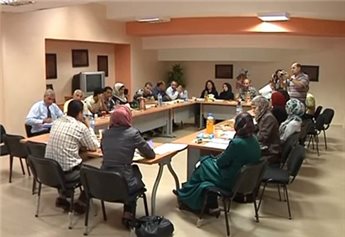
A meeting held by the Palestinian Center for Democracy and Conflict Resolution in Hebron on Tuesday discussed the media's role in cases of killing women.
The Centre's director, Saad Shalaldeh, set out the Centre's role in supporting women's issues and its programmes aimed at strengthening human rights, pointing out that the Centre has dealt with more than 400 cases of violence against women during this year, among them 16 killings.
He pointed to the cooperation between the Centre and media, official and civil organisations in helping these cases, and expressed the Centre's readiness to cooperate with the media in opposing violence against women in all its forms, through the Centre's activities of workshops and media meetings to win public opinion and support women.
For her part, the legal adviser at the Ministry of Justice, Bayan Al-Qawasmi, spoke about the media's powers in law, explaining that the Palestinian media operates on its own judgement and that there is no law defining its powers in these cases. She pointed out that the media code of honour is a general international rule in the absence of laws and legislation.
She noted how the Palestinian media deals with cases of killing women, and how journalists hold back from addressing this issue and handling it in a sound media and professional manner, because of its sensitivity in relation to honour and virtue.
Al-Qawasmi called for the importance of journalistic specialisation in various fields, among them community issues and women's issues, given its importance in understanding women's reality and their problems and in addressing them.
The media professional Naila Khalil spoke about the obstacles facing journalistic work in reaching judicial institutions to follow an event, pointing out that access to these institutions comes through a journalist's personal relationships with them.
She said the media has a social, moral and professional responsibility in dealing with women's issues, and stressed that the killing of women is a crime of murder regardless of its motives.
She added that there is no law on the freedom of journalistic work, only draft laws governing journalists' performance and work, and that there is no specific law protecting them in dealing with all the cases relating to women.