Speakers call for supporting the rights and work opportunities of people with disabilities in the country's governorates
Gaza, Publication and Information Unit:
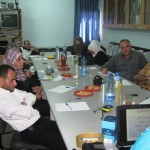
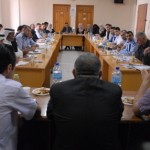
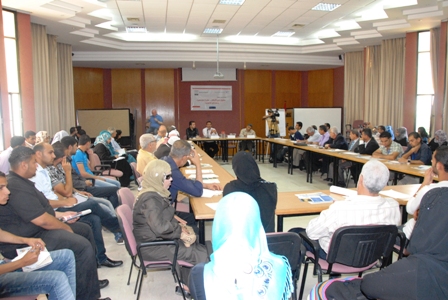
Speakers and participants called for the need to support the rights and work opportunities of people with disabilities in the governorates of the Gaza Strip and the West Bank and to enact laws supporting the inclusion of this group in society. These recommendations came during a workshop held by the Palestinian Center for Democracy and Conflict Resolution within the Justice for All project, entitled "The rights of people with disabilities: a community view and legal protection", at the premises of the Atfaluna Society for Deaf Children in Gaza, with the participation of 80 people representing organisations, reconciliation figures and individuals with disabilities.
At the start of the workshop, the director of the Atfaluna Society for Deaf Children, Naim Kabaja, stressed that his association has been keen to provide the best services and support to deaf people within the local community since 1992. He added: "Unfortunately, society's view of deaf people is negative because of the difficulty of communication between the two sides, and so we are keen to teach sign language each year to dozens of organisations and individuals through training courses."
Kabaja went on to say: "Among the main difficulties deaf people face is the shortage of work opportunities, despite their high competence and expertise, but they are rejected by companies and ministries that refuse to include them and to give them their professional and social rights." He explained that recent studies have shown that a number of people exploit deaf people, particularly children among them, given the difficulty deaf children have in expressing the violations they are subjected to in their daily lives.
For his part, the chair of the board of the General Union of Disabled People, Awni Matar, pointed to the need to change the negative view of people with disabilities and to give them genuine opportunities for work, education and vocational training in the Gaza and West Bank governorates. He said: "The directors of the media must carry out considered and systematic programmes discussing the activation and inclusion of people with disabilities in society and in institutions, in addition to working to halt the legal decisions that conflict with the labour law within government systems."
Matar called for working to open schools dedicated to people with disabilities, to introduce training material teaching sign language in schools, to provide tax facilities for workers with disabilities and to increase their share of vocational training at educational institutions. He stressed the need to move quickly to produce an identity card for people with disabilities and to include them in shaping the various policies and plans within society, and to support Palestine's representation through cultural, sporting and political achievements.
In an address on behalf of the Ministry of Labour, the ministry's legal counsel Mohammed Al-Haddad reviewed the main laws supporting people with disabilities, among them the Basic Law and the Palestinian labour law no. 7 of 2003, which obliges the employer to employ a number of people with disabilities in private establishments. He pointed out that his ministry has imposed laws for monitoring and following up the conduct of procedures for employing people with disabilities, and that in the future they will record violations and file breaches against employers who breach the law.
Al-Haddad explained that the ministries of labour and social affairs provide a set of service packages to people with disabilities, among them assistive devices such as medical mattresses and wheelchairs, and services including temporary work opportunities and social assistance. He expressed the hope that the coming period would see more assistance provided and continuous channels of communication opened with the organisations caring for people with disabilities, supporting them in a way that ensures their proper inclusion in society.
It is worth noting that the Justice for All project at the Conflict Resolution Center is carrying out a range of workshops during the current period on a number of community issues that touch the citizen's daily life, and on bringing views closer together and building communication between decision-makers and citizens in the Gaza governorates.