Speakers recommend strict measures to address the phenomenon of child labour in Palestine
Gaza, Publication and Information Unit:
Speakers and participants recommended the need to impose strict measures to address the striking phenomenon of child labour in Palestinian society and to press government bodies and organisations to end the violations against children at work in the Palestinian territories.
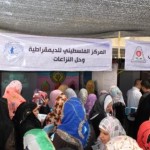
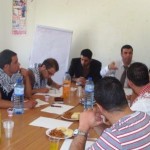
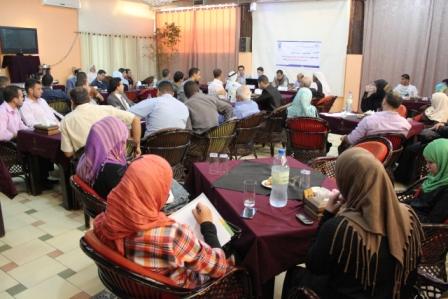
These recommendations came during a workshop entitled "Child labour: legal dimensions and strategic solutions", held by the project "Stronger oversight, better justice" at the Palestinian Center for Democracy and Conflict Resolution at the La Terrazza restaurant in Gaza City, with the participation of a group of government officials and representatives of civil society and the legal profession in the Gaza Strip.
At the start of the workshop, the adviser to the Ministry of Labour, Mohammed Al-Haddad, spoke about his ministry's supervision of child labour, and particularly its concern that there be a contract and an employment relationship between working children and employers. He stressed that the ministry inspects premises and uncovers violations against children, and that penalties are referred to the public prosecution for the necessary legal action.
For his part, the childhood counsellor at the Ministry of Social Affairs, Mohammed Al-Kahlout, said: "The main causes of child labour go back to difficult economic conditions, sometimes connected with the death of the head of the household or with divorce, poverty and the siege, all of which are factors that affect children negatively." He explained that social affairs helps distribute monthly food parcels, in addition to continuous coordination with the ministries to create job opportunities and to hold workshops making parents aware not to expose their children to exhausting work unsuited to their age.
On educating children inside schools, the head of the educational counselling department at the Ministry of Education, Anwar Ahmed, pointed out that the ministry motivates pupils to take a greater interest in education and to reduce the problem of dropping out, alongside an improvement in the educational programme. He added: "The most prominent role within the school falls on the educational counsellor in reducing the problem of dropping out, which increases the phenomenon of child labour. We provide psychological support and strengthen extracurricular activities, among them the arts and the library, which help the child feel they belong at school."
For his part, the legal expert Salah Abdel Ati of the Independent Commission for Human Rights called for forming a national committee, in coordination between government frameworks and institutions, to follow up the achievement of realistic solutions that reduce child labour in Palestine, which has reached serious figures, with children making up 53% of the population in Palestine. He said: "The consequences of child labour on this scale are grave: the number of children working under the legal age in the Middle East is 29 million, in addition to the unemployment rates spreading through successive generations without any awareness of how to emerge from this impasse."