
Officials and economists call for ending the division because of its devastating effects on Palestine's economy
Hebron, Publication and Information Unit:
Officials and economists called for moving quickly to end the political division between the two parts of the homeland in the West Bank and the Gaza Strip, because of its devastating effects on the economy, local production and income and on the inability to build and develop the wheel of the economy, owing to the political crisis that has continued for eight years.
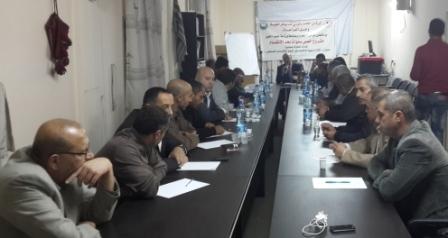
These calls came during an economic workshop organised by the Palestinian Center for Democracy and Conflict Resolution at the premises of the Chamber of Commerce and Industry of South Hebron governorate, entitled "The effect of the division on the Palestinian economic situation", with the participation of a group of officials from the Ministry of Economy, traders, and the directors of factories and economic companies in the West Bank.
At the start of the workshop, the director of the Palestinian Center for Conflict Resolution branch, Saad Shalaldeh, stressed that his Centre supports every step aimed at strengthening Palestinian reconciliation and developing all fields of life, foremost among them the economy. He explained that the Coalition of Civil Forces at the Centre addresses many groups in the local community in order to establish the concepts of respect for others, to deepen constructive dialogue and to move towards a cohesive and solid society able to face all the challenges of the occupation, the siege and the wall.
For his part, the president of the Chamber of Commerce and Industry of South Hebron, Jalal Makharzeh, stressed that the Palestinian economy's productivity has fallen to very low levels as a result of the geographical separation and the absence of communication between officials in the West Bank and the Gaza Strip. He expressed his hope that all the crises will be addressed in a way that raises the quality and strength of the Palestinian economy, so as to establish a Palestinian economic front capable of production and of competing in the various markets.
For his part, the official responsible for chambers of commerce at the Ministry of Economy, Ahmed Al-Farra, pointed out that the lack of variety in agricultural seasons is due to the shortage of vegetables imported from the Gaza Strip, and hence to the rise in vegetable prices in West Bank markets. He added: "The Ministry of Economy has suffered losses in tax revenues, which fell from 28% before the division to 3% afterwards, and the annual loss to the state budget is 30 to 35%. Among the causes of the loss is traders concealing the revenues of their purchases, which reduces the taxes paid to the government."
For his part, the director of income tax in South Hebron, Yasser Al-Salamin, pointed out that the value of added tax has risen several times over and has become doubled for the West Bank and Gaza, so that traders and factory owners pay taxes to both governments amid poor economic and political conditions. He explained that the banks suffer from clean and unclean deposits belonging to figures backed by factions, alongside money laundering and the lists of terrorist organisations, which leads to a fall in the banks' revenues and has a negative effect on the state budget.
On the negative effects on crop and livestock production, the agricultural engineer Majdi Amro of the Chamber of Commerce and Industry of South Hebron said that the fall in crop and livestock production rates in the West Bank, because of the division and the failure to bring agricultural products and pesticides from the West Bank into Gaza, has led to a shortage in production and in imports from the Gaza Strip. He noted that improving crop and livestock production will improve the strength of the economy and reliance on alternatives and productive elements, which will have a positive effect in the future on increasing income for Palestinian families and on supporting varied productive projects.
In a related context, the director of the Al-Jibrini dairy factory in the West Bank, Jihad Al-Jibrini, explained that the rate of sales in the dairy trade has fallen to 2% since the division between the Fatah and Hamas movements, stressing that this disaster has damaged dairy production and made it impossible to reach the agents and the users of our products in the Gaza Strip in order to settle the debts accumulated by customers.
On the harm to the stone sector, the manager of a stone business in Hebron, Hassan Al-Zaarir, expressed his frustration at sales falling to zero after having been 60% before the division, because of the difficulty of exporting stone to the Gaza Strip as a result of the siege imposed on the Strip. He pointed out that the stone trade suffers from the high customs prices for transporting stone and marble to Gaza, since it is moved through Jordan, Egypt and the tunnels to reach buyers in Gaza.