Officials and speakers call for advancing the wheel of the judiciary and achieving justice in the Gaza Strip
Gaza, Publication and Information Unit:
Officials and speakers called for the need to develop the judiciary and justice in the courts in the Gaza Strip, to increase the number of judges at the regular courts to determine citizens' cases, to work on activating responsible oversight of the enforcement departments within the courts, to call for the return of the judges who have withheld their work, and to activate a prosecution and courts for juveniles.
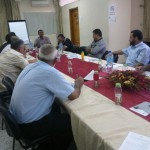
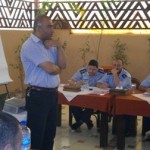
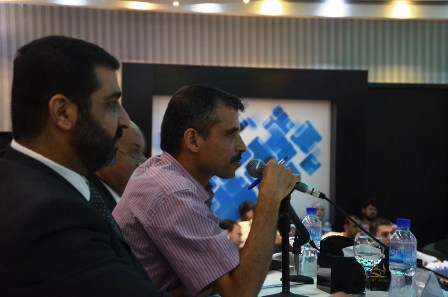
These recommendations came during the conference "Slow justice: difficulties and solutions", held yesterday by the Palestinian Center for Democracy and Conflict Resolution at the Orient House Hotel in Gaza City, with the participation of a group of judges, lawyers, reconciliation figures, representatives of human rights centres and civil society organisations, and law students at the universities.
At the start of the conference, the chair of the board of the Palestinian Center for Democracy and Conflict Resolution, Eng. Khaled Zeidan, stressed that the Centre follows citizens' difficult cases, which touch society as a whole, and that the Centre's role lies in supporting the judiciary by activating frameworks that assist it, such as mediation and arbitration, and developing the work of the reconciliation committees, complementing the role of the official judiciary. He added: "The Centre's philosophy relies on the methods of mediation and arbitration and on communicating with reconciliation figures, drawing on tribal adjudication in support of the official judiciary, in order to address the cases coming before the courts in the Gaza governorates."
In the address on behalf of the Palestinian Ministry of Justice, Yaqoub Al-Ghandour, representing the office of the minister of justice in Gaza, spoke of how his ministry has been able to achieve a set of judicial and executive measures in the courts in order to end citizens' suffering, and that the coming period will see an increase in the number of judges by appointing 10 new judges to make it easier to complete the cases resting on the judges' shoulders. He called on the judges and court staff who have withheld their work to return quickly to their posts in order to work towards the rule of law and the application of justice in all the country's governorates and to serve all members of Palestinian society.
In the first paper, entitled "The slowness of litigation procedures in the regular courts", Judge Diya Al-Madhoun, president of the Gaza Court of First Instance, pointed out that an independent judiciary is one of the basic pillars of society's stability and that the values of integrity and transparency in the judiciary are tied to its reality and its standing in society, through providing the basic material and human resources for the judiciary. He considered that the slowness in the course of cases and their procedures is due to the small number of judges in the courts in the Gaza Strip, numbering 40, in addition to a single judge handling 30 cases in one court session.
Al-Madhoun went on to say: "The human resources of the courts are limited: the number of staff at all the courts in the Gaza Strip is 192, and 2011 saw a major achievement by the regular courts in handling 6,000 cases to restore rights to their owners, even though the number of judges at the Gaza Court of First Instance is 8." He stressed that the Palestinian judiciary at this stage is effective and productive, achieving security and economic stability, despite the need to increase the material infrastructure of buildings and courtrooms to establish its standing and to activate electronic information systems in order to make future consultation easier through the internet.
The second paper, entitled "The difficulties of the enforcement departments in the regular courts and the ways of addressing them", was presented by lawyer Safi Al-Dahdouh, who spoke about the insufficient number of judges to determine enforcement cases, the limited days set for receiving the public and lawyers, working hours at the courts ending at half past twelve, in addition to the small number of staff in the enforcement departments. He explained that irresponsible measures by some court staff prolong the enforcement of writs, as does the unjustified refusal to receive applications at the courts because the location of files is unknown, and the growing queues of lawyers and members of the public at the court complexes in the Gaza Strip.
Hatem Al-Faqawi, head of the prosecution for government cases and the High Court of Justice, discussed in his paper entitled "The components of the judicial authority: roles and responsibilities" the achievements secured by the public prosecution through establishing, for the first time, a prosecution office for organisations and associations within the specialised prosecution structure, to investigate board members and staff of associations in crimes committed inside those organisations and associations. He added: "The public prosecution has achieved the swift completion of investigations in minor misdemeanours where the accused confess to their offences and sufficient evidence is available, so that a suspended prison sentence or a deterrent fine can be imposed on the accused."
Al-Faqawi called for the need to press for the establishment of an advanced forensic laboratory and a department of forensic medicine and criminal evidence, and to equip them with the most modern resources and human staff possible, as well as for the views of the public prosecution and the judiciary to be taken into account in all draft criminal laws relating to the judicial authority. He explained that establishing courts specialising in hearing criminal cases will help speed up the determination of those cases, so as to reduce the slowness of litigation procedures and achieve judicial justice more quickly, as he put it.
In the fourth paper, entitled "Mediation and arbitration: frameworks assisting the judiciary", the lawyer and international arbitrator Adnan Abu Moussa set out the interest of citizens who are parties to disputes in arbitration, because of their wish to settle their disagreements in a simple way away from the cost and hardship of the judicial system, in addition to the fact that litigation procedures require a great deal of time and effort and that the multiple levels of litigation, between magistrates, first instance, appeal and retrial, prolong the process. He added: "Arbitration is not a substitute for the official judiciary but an assistance to it, in what it relieves of the cases that weigh on the judiciary, and this is achieved in accordance with the principles set out in the law. Arbitration also drives the wheel of the economy forward, encourages foreign investment and keeps national and official law from being subject to any external influences when rulings are determined."
Those attending the slow justice conference called for the need to end the political division between the two parts of the homeland in order to end the Palestinian citizen's suffering and to achieve national and political unity, which affects every aspect of life, as well as for tenders for judicial notifications to be awarded to private companies that would notify the parties to cases instead of the police or police process servers, in order to ensure notifications are completed more quickly and that the judiciary's work continues without disruption.