Participants call for increasing popular and public mobilisation to achieve civil peace in the Palestinian territories
Middle governorate, Publication and Information Unit:
Participants and speakers called for the need to increase popular and public mobilisation to achieve civil peace, to strengthen the principle of dialogue between the groups of the local community in order to resolve community disputes and conflicts, and to seek to strengthen student initiatives supporting civil peace in the Palestinian territories.
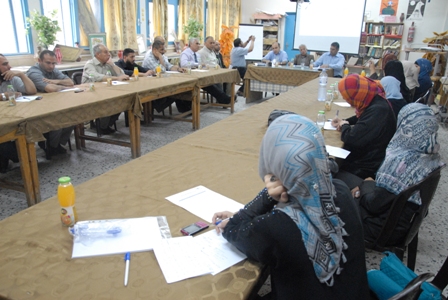
This came at a meeting held today by the Coalition of Civil Forces for Civil Peace at the Palestinian Center for Democracy and Conflict Resolution, entitled "Strengthening a culture of civil peace in educational institutions", with the participation of a number of school heads and counsellors and representatives of the central parents' council, attended by a number of reconciliation figures at Al-Bureij Preparatory School (B) in the Middle governorate.
At the start of the meeting, the field coordinator of the Coalition of Civil Forces for Civil Peace, Fayez Zaqout, stressed the role educational institutions play in changing concepts and strengthening the foundations of tolerance and affection between people, by increasing awareness of accepting others inside schools and universities. He praised the good relationship between the Conflict Resolution Center and educational institutions, particularly with the United Nations Relief and Works Agency (UNRWA), in bringing up pupils on concepts that strengthen their belonging to and love for their communities.
For his part, the supervisor and counsellor of the human rights programme at UNRWA, Ibrahim Wishah, spoke about directing all forms of support and full advocacy to the cause of the prisoners on hunger strike in the occupation's jails in the battle of the empty stomachs. He explained that they are keen to hold to the right of return for all refugees to their towns and villages and to press for the application of the resolutions of international legitimacy, particularly resolution 194, on the sixty-fourth anniversary of the Palestinian Nakba.
Wishah reviewed the Agency's role in rooting human rights concepts in schools through a curriculum designed to plant a culture of tolerance and acceptance of others among pupils and to reach a safe community environment for everyone. He explained that the Agency runs a number of joint cooperation programmes with the Conflict Resolution Center on questions of student mediation, with the aim of resolving disputes between pupils in a diplomatic way through dialogue, away from resorting to the various forms of violence.
For his part, the representative of the central parents' council, Zaher Al-Afghani, pointed out that the council is keen to deepen the language of dialogue inside the school and in continuous coordination with parents, and to work on following up all the problems that may arise between pupils and their families. He stressed that the coming period will see increased community dialogue between pupils and their peers on the one hand and with their families and neighbours on the other, through carrying out a range of workshops and events supporting the achievement of civil peace.
The participants recommended the need for sincere intentions to end the state of division and its effects on civil peace, stressing that it is the people's will that holds the power to change for the better, removing all the social, economic and cultural causes that prevent the spread of the concepts of civil peace, and being keen to form student councils in the form of student parliaments that support human rights and civil peace.