A debate on young people's political participation in decision-making
Gaza, Publication and Information Unit
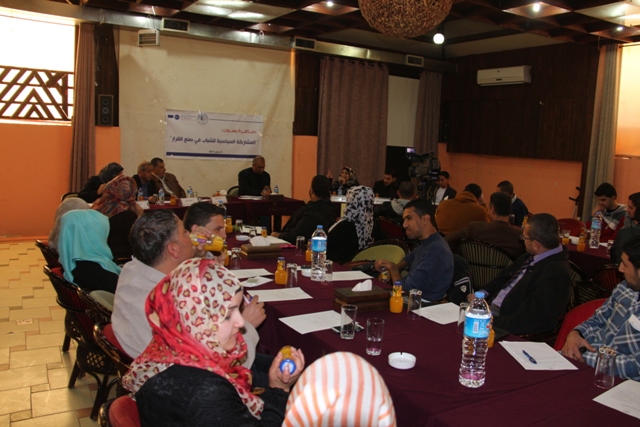
On Wednesday the Palestinian Center for Democracy and Conflict Resolution, in partnership with the National Endowment for Democracy, organised a debate at the La Terrazza restaurant entitled "Young people's political participation in political decision-making", within the project "An advanced step towards civil peace". It was attended by the projects director at the Palestinian Center for Democracy and Conflict Resolution and chair of the session, Mr. Abdel Moneim Al-Tahrawi; representing the opposing team, Dr. Ahmed Al-Mudallal, a leader in the Islamic Jihad Movement, Dr. Amal Hamad, member of the central committee of the Fatah Movement, and Mr. Jamil Mezher, member of the political bureau of the Popular Front; and, for the supporting team, the youth leaders Hanin Abu Hamda, Zarif Al-Ghara and Murad Abu Ghoula.
Mr. Abdel Moneim Al-Tahrawi opened the session by putting the debate's central proposition: "Young people believe that political parties neither help nor push young people to enter political decision-making." He stressed that debates of this kind, held by the Conflict Resolution Center, are not about deciding a winner and a loser but about developing and strengthening the language of dialogue between young people and political officials.
Hanin Abu Hamda, from the team supporting the proposition, explained that the role of young people in political parties and decision-making centres is a marginalised one, that their rate of participation is negligible, and that young people are a tool for carrying out political decisions they have no hand in making, with no effective or influential role in political decisions. She deplored the emigration of young people and their creativity abroad while they are unable to be creative in their own country, which should regard them as partners in the profits just as they are partners in the capital.
For his part, Dr. Ahmed Al-Mudallal, a leader in the Islamic Jihad Movement, stressed that political parties and movements arose only from young leaders who struggled to found them, and that the Islamic Jihad Movement is a young movement in which many positions and posts are held by young people. Answering young people's questions about the creativity allowed to young people abroad and the restrictions in Palestine, he attributed this to the difficult political situation the Palestinian people live in, which is entirely different from the comfortable democratic European setting. He said that despite this difficult situation, without the participation of young people a party cannot resist and rise against this occupation, but that they cannot cancel out the experience of the senior leaders and long-standing officials in the party.
For his part, Zarif Al-Ghara, the second speaker for the proposition, upheld the case they were defending by presenting a set of pieces of evidence and arguments in support of it. He stressed that at the political level there are no young representatives taking part in political decision-making, while there are plenty of young people at the levels that always pay the price, and that their aim as young people is to stand side by side with the leaders and officials in shaping the political vision and decisions, which is one of their natural rights.
Mr. Jamil Mezher, member of the political bureau of the Popular Front and second speaker against the proposition, expressed in the course of his reply to the supporting team's arguments his hope for young people's participation in parties and political decisions, but said this requires tireless work and effort from young people if they are to have effective and influential roles at the political level. He said renewal and change are needed in political positions and are not confined to the senior leaders, that young people are the fuel of the revolution, and that rights are seized rather than granted, so they need to struggle to seize their right to participate and to be worthy of making political decisions.
Murad Abu Ghoula, the third speaker for the proposition, stressed that the culture of political parties is a paternalistic culture and that young people's lack of participation in politics is not a legal matter but a social and cultural problem, and that there must be a clear strategy for young people to enter and take part in political decision-making.
Dr. Amal Hamad expressed her pleasure at young people's culture and awareness and said they were the ones who steered the compass and carried the banners from the beginning. She said the Fatah Movement is full of youth participation and student bodies, but that it is effort that secures this for young people, and that young people's reaching political decision-making centres is a right and a just entitlement. She cited in support of this the experience of women's activism, through which women were able to establish their right to political participation, calling on young people to follow the same approach of demanding and taking the initiative, and not to confine the matter to dreams and wishes alone.
At the end of the debate it was clear that the young people's central proposition, that they are not given sufficient space to participate, had met with the agreement of those present, in addition to the opposing team's acknowledgement of the proposition through their repeated affirmations that they are not a party against what the supporting team was saying, because it is the truth, and that the supporting team had the awareness and the culture of dialogue with which to persuade the audience of their view.
In closing, the director of the Palestinian Center for Democracy and Conflict Resolution thanked everyone, supporters and opponents alike, for this debate, and called for young people to be given wider space in decision-making, particularly in student bodies, and said there is no need to refer back to the senior leaders on every decision, especially those concerning students in the Palestinian universities.