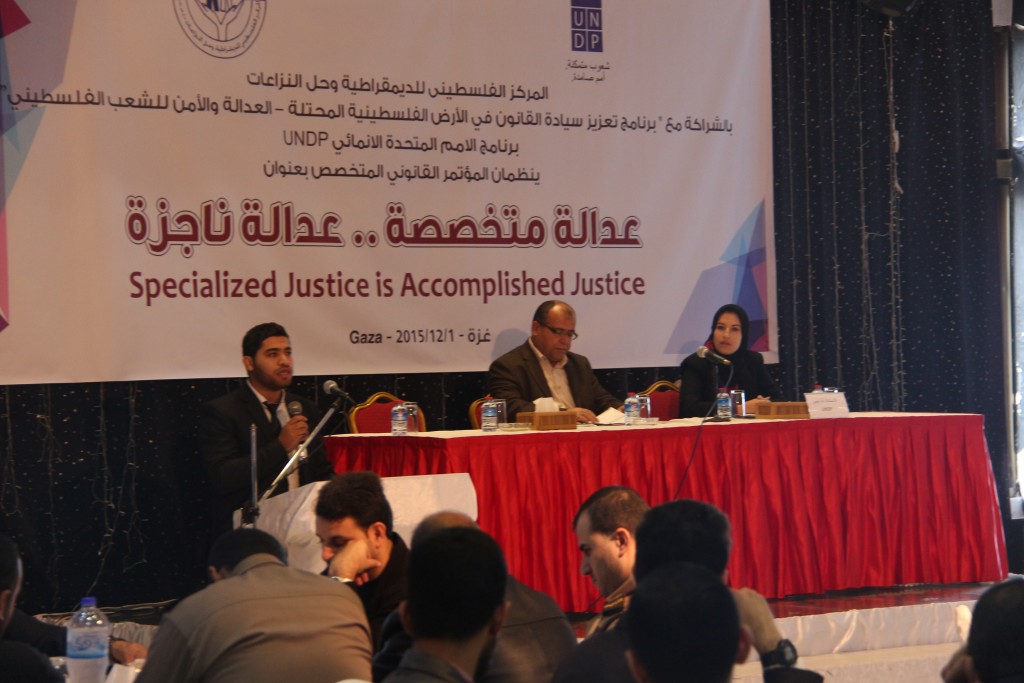
The Palestinian Center organises the conference "Specialised justice, effective justice"
The Palestinian Center for Democracy and Conflict Resolution organised a conference entitled "Specialised justice, effective justice", in cooperation with the United Nations Development Programme (UNDP), as part of the events of the project "Towards a more responsive justice system in the Gaza Strip (Istijaba)". The conference aims to strengthen the principle of judicial independence, achieve effective justice and support freedoms and human rights.
Specialists taking part stressed the importance of moving quickly to end the division as a prelude to unifying the judicial apparatus, with Palestinian legislation to be unified in a way that suits the needs of society and international conventions, and with a specialisation-based approach adopted to develop judicial work and establish the principle of justice away from political tugs of war.
At the start of the conference Saeed Al-Muqadama, director general of the Centre, gave an address in which he stressed the need to restore national unity and to enable qualified and specialised staff of the justice bodies to return to their posts.
In the address on behalf of the United Nations Development Programme, Aya Bashir said that a fair and effective legal system is a basic condition for participatory democracy and helps vulnerable groups, particularly women, to gain access to the legal measures that guarantee citizenship and human rights.
In the conference's first session, Judge Hamed Al-Samak addressed the theme of specialisation in the judiciary as an advanced step on the road to effective justice. He noted that the Basic Law provides for the swift determination of cases and for an independent judiciary, and also provides for the establishment of sharia, military and administrative courts and of the constitutional court, while the law of civil and commercial procedure sets out the courts' jurisdiction in terms of cases and of value-based and local jurisdiction. He stressed the need to unify the judicial council and the laws in force in the areas of the National Authority, explaining that this will not be achieved without ending the destructive division.
Mohammed Murad, representing the public prosecution, stressed that adopting a specialisation-based approach is the most important tool for developing and advancing judicial work, and that this depends on establishing courts and prosecution offices distinguished by the competence of their staff, the quality of their decisions, the effectiveness of their procedures and the provision of legal services that take account of specialisation in terms of diversity, clear legal texts and modern technology.
He stressed the need to strengthen judicial specialisation and specialised training for public prosecution staff, as well as to develop the forensic laboratory and forensic medicine, and to address the chaotic state of the laws and align them with international conventions.
Wiam Matar, representing the police, addressed the juvenile police project and its role in criminal justice, aimed at settling disputes, resolving cases involving juveniles, investigating crimes committed, following legal procedures, and reforming the delinquent juvenile and reintegrating them into society.
In the conference's second session, lawyer Safi Al-Dahdouh, deputy head of the Bar Association, set out the Association's vision for specialisation in the justice bodies, pointing to the need for an integrated judicial system, for a strategy to end the judicial division, for mechanisms of specialisation for the justice bodies, for premises in which judicial work can be carried out, for the necessary administrative staff, and for establishing the rules of justice and fairness away from political tugs of war.
For his part, the academic Ayman Abdel Aal reviewed the Egyptian experience of specialisation in the justice bodies, pointing to the establishment of the economic courts and the child court as models of specialised courts in Egypt for the swift disposal of cases. He explained the disputes and actions falling within the jurisdiction of the economic courts, as with the child court, which is regulated by the Egyptian child law for the care and protection of childhood.
The conference featured many discussions and recommendations, among them working to end the division as a prelude to unifying the judicial apparatus, increasing the number of qualified staff across all the justice facilities, unifying Palestinian legislation and laws in a way that suits the needs of society and international conventions, drawing on the experience of neighbouring states, particularly Egypt, in establishing specialised prosecution offices and courts, strengthening training, executing judgments swiftly, and guaranteeing rights for all.