The Palestinian Center announces a position paper on improving the protective environment for children against sexual harassment and submits it to the Palestinian Prime Minister
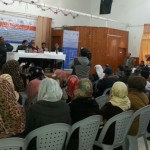
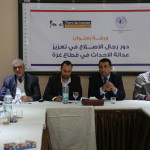
The Palestinian Center for Democracy and Conflict Resolution today held a closing workshop to announce a position paper on improving the protective environment for children against sexual harassment, as part of the events of the project "A protective environment for children against sexual exploitation", carried out in the Gaza Strip and the West Bank, which aims to improve the ways of protecting children at risk of sexual exploitation through community protection mechanisms.
The workshop was opened by the director of the Palestinian Center, Mr. Saeed Al-Muqadama, with an address in which he explained that sexual violence against children is a grave violation of the rights of the child and, in law, a heinous crime. He noted that most children and families do not report cases of abuse and exploitation because of stigma, fear and lack of trust in the authorities, and that social intolerance and lack of awareness also contribute to weak reporting,and so the Centre views with concern the rising number of these sexual assaults against children. There is no justification for silence in the face of it; confronting it has become urgent and necessary; and responsibility here is shared and cannot be assigned to one body to the exclusion of another. This calls for a serious collective stand on the mechanisms of confronting and protecting against such assaults, going beyond apportioning blame and holding particular parties responsible.
This was followed by a presentation of the project's main achievements, which showed that there have been more than 1,017 cases of children subjected to sexual harassment, even though the project covered only the northern and southern governorates of the country. The project "A protective environment for children against sexual exploitation" included many events, workshops and round tables, carried out with many bodies directly connected to the judiciary, such as the police, the public prosecution, the judiciary, forensic medicine and civil society organisations directly connected to the arms of justice. Through these meetings a number of criticisms and observations were gathered on the negative procedures that affect the course of proceedings and obstruct the possibility of reaching the justice sought with the effectiveness the law provides for. The outcome was the drafting of a policy activation memorandum, to be taken to decision-makers at the High Judicial Council, the Legislative Council and the ministries of justice, interior, social affairs, education and health, so that they do everything necessary and everything possible to ensure the proposed recommendations are activated and applied.
The Centre then announced the position papersubmitted to His Excellency the Palestinian Prime Minister, Prof. Rami Hamdallah, on the basis of which a petition was drawn up to collect as many signatures as possible in the field and online. Each of them included the following recommendations and demands:
1. Moving quickly to approve the draft Palestinian penal code of 2003 in accordance with international human rights and child rights standards, with the necessary amendments to increase deterrence in sexual offences.
2. The need to establish special courts to hear cases of sexual offences, comprising a specialised prosecution and judiciary, with an appropriate time limit set for ruling in such cases in order to protect victims from having their cases heard in public and to close in on the perpetrators.
3. The need to establish safe houses for child victims of sexual assault, particularly where the assailant is from the same family or where the victim's family is broken and does not provide a supportive environment for the victim.
4. Establishing reform and rehabilitation centres for juvenile offenders in these cases, staffed with the best professionals to treat them psychologically and reintegrate them socially once their sentence has been served, given how important it is that they do not fall back into delinquency. In this connection, the role of probation officers and protection counsellors in the major governorates should be activated.
5. The need to appoint a sufficient number of forensic doctors across the country and to raise their competence through continuous training, and to equip central forensic laboratories in the major governorates, in order to expedite decisions on the technical aspects of cases.
6. Integrating sex education in schools through activities that enrich the curriculum, so as to make children aware of the inviolability of their bodies, and activating the role of school counsellors and head teachers by continually urging the Ministry of Education in this respect.
7. Forming a committee of inquiry to examine the reasons why so many files on sexual assault against children are closed at the police and the prosecution, since it is rare to see harassment or assault cases in which punishment is imposed.