Politicians and intellectuals call for unifying national identity and keeping it out of political and intellectual disputes
Gaza, Publication and Information Unit:
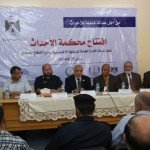
A group of politicians and intellectuals in Gaza called for unifying Palestinian national identity despite intellectual and political differences, and for focusing attention on fighting the brutal Israeli enemy, which represents the real conflict of the Palestinian people. This came at the second intellectual meeting held by the Palestinian Center for Democracy and Conflict Resolution yesterday, Monday.
Mr. Iyad Abu Hjair, director of the Gaza branch, spoke of the importance of this meeting, saying it aims at discussing intellectual differences and their reflection on the state of Palestinian division, the intellectual points of reference of the Palestinian parties and factions, in addition to the form of Palestinian national identity and the ability of the Palestinian political system to accommodate all these intellectual differences.
Abu Hjair added: "Intellectual division is one of the real causes of Palestinian division as a whole, and the conflict has shifted from fighting the Zionist enemy to fighting the components of Palestinian society. In addition, the intellectual differences over the nature of the future state of Palestine, between the Islamic and the liberal (with reservations about the labels), are what turned the compass away from achieving the real aim of the state."
For his part, Mr. Maher Issa explained that the idea of one current excluding another is a rejected idea and has proved its failure in earlier stages, noting that the source of the intellectual differences goes back to the existence of two different programmes for the two ruling currents and the difficulty of reaching common ground that brings them together.
As for Mr. Imad Abu Rahma, member of the general central committee of the Popular Front for the Liberation of Palestine, he noted in his remarks that national identity is a compound of a set of components, the most important of which is the national component, and that it is in a state of development and growth as political, economic and social conditions change. He added: "The problem in the intellectual differences between the political currents lies in the absence of sufficient democratic maturity among the political leaders, in accepting the other and acknowledging its existence, and there is no peaceful transfer of power, which has been reflected negatively on the national project."
The participants also stressed that the Palestinian people must unite and take part in formulating and defining their identity and in keeping it out of party disputes and squabbles, for their common good.