Conflict Resolution Center holds a workshop on the guarantees of criminal justice for juveniles
Gaza, Publication and Information Unit:
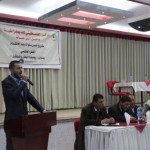
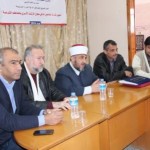
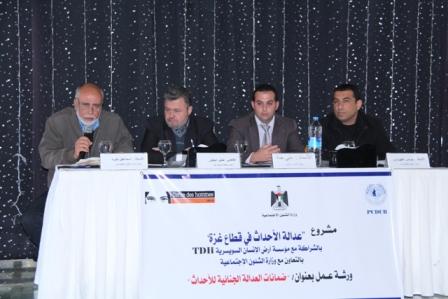
The Palestinian Center for Democracy and Conflict Resolution held a workshop on "The guarantees of criminal justice for juveniles", within the events of the juvenile justice project in the Gaza Strip, carried out in partnership with Terre des hommes Switzerland (TDH). The workshop was held at the Orient House Hotel and attended by 96 participants from the judiciary, the public prosecution, the Ministry of Social Affairs, probation officers, the social workers and psychologists working at the Al-Rabee institution, activists in the field of childhood, lawyers, mukhtars, representatives of civil society organisations, police officers, investigation inspectors, university students and other interested people.
Lawyer Anwar Azzam opened his chairing of the workshop by welcoming the participants and praising their role in seeking to create better justice for juveniles and to find solutions to what obstructs the implementation of the law on cases of children in conflict with the law.
For his part, Younis Al-Tahrawi, head of the legal unit at the Conflict Resolution Center, said in his address: "The project seeks to create a better legal reality for juveniles by identifying some of the difficulties that beset work in the field of juveniles, foremost among them the probation officers, who play an important part in this field."
He set out some of the activities carried out through the project, among them training probation officers, investigation inspectors and mukhtars, and the meetings held with probation officers and what they produced in the form of the juvenile justice committee, and how important that committee is.
Al-Tahrawi stressed the need to develop the committee's work so as to ensure the continued provision of services to children in conflict with the law and make it easier for them to reach justice, calling for work to improve juvenile trials, to establish courts dedicated to them and to separate them from trials held for adults.
He noted that the most important achievement of the committee, which brings together the public prosecution, social affairs, the interior ministry and reconciliation figures, is the issuing of the attorney general's instructions no. 25/2013, which require a probation officer to attend questioning.
In his address, Judge Khalil Al-Batsh, president of the Gaza Magistrates' Court, raised the point that the judiciary's task is first and foremost to achieve justice and to apply the law without any breach of its texts, explaining that the flaw affecting juvenile justice lies in probation officers not attending trial sessions in some cases.
He added that the public prosecution bears a great responsibility, namely to be precise in bringing charges against a juvenile, which is what obliges the judiciary to issue its rulings in accordance with the papers and evidence placed before it.
Al-Batsh pointed out that the responsibility for achieving the best justice for a juvenile falls on everyone, stressing the importance of having a dedicated police force to deal with juveniles and the need to rehabilitate the juvenile religiously so that the phenomenon of juvenile delinquency is brought to an end.
In his paper, Ali Khella, representing the public prosecution, stressed that the prosecution spares no effort in providing help and assistance for the sake of children in conflict with the law, noting that the main problem besetting work with this group in Palestine, and particularly in the Gaza Strip, is the age of the laws governing juvenile cases and their failure to suit the juvenile's circumstances and age.
He added that the multiplicity of laws, the slowness of trials and bringing juveniles before the court harm them, and that we have held many meetings to resolve some of these difficulties and have submitted recommendations to the Judicial Council to expedite the trial of some juveniles and to follow up their cases.
He pointed out that prosecutors have been required to liaise with probation officers so that they attend the questioning of juveniles and to attach the probation officer's report to the juvenile's file, stressing that the situation of juveniles needs further efforts to improve their legal position. He closed his address by thanking the Conflict Resolution Center and the supporters of the juvenile justice project for holding this important and effective workshop.
In a paper presented by Ismail Tanira, director of the social defence department at the Ministry of Social Affairs, he set out the nature of the department's work and the powers assigned to it.
He said the small number of probation officers at the ministry and the limited material resources form an obstacle to probation officers carrying out their work as required, and that the department has submitted recommendations to increase the number of probation officers given the growing number of juveniles held at the Al-Rabee institution, and that the work of probation officers is very important in correcting a juvenile's behaviour in order to reform them and reintegrate them into society.
The floor was opened for discussion and interventions, which ended with some of those present putting questions centred on the severity of the penalties imposed on some juveniles and on the need for penalties to suit the juvenile's age and circumstances.
Those present praised the holding of this workshop, given its importance in terms of the target group and the attendance of all the public figures and the organisations concerned with securing the interests of juvenile children, and the importance of the committee arising from the project and the need for its work to continue without interruption in order to achieve better justice for the juveniles held at the Al-Rabee institution for social care.