Conflict Resolution holds a meeting on the obstacles to probation officers' work during juvenile trials
Publication and Information Unit:
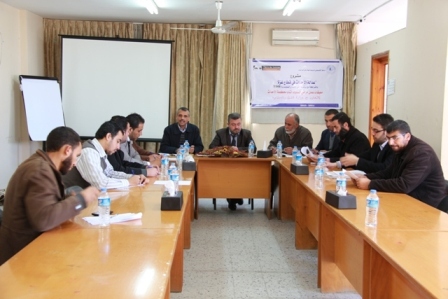
The Palestinian Center for Democracy and Conflict Resolution, in cooperation with the Ministry of Social Affairs, held a meeting on "The obstacles to probation officers' work during juvenile trials", within the events of the juvenile justice project in the Gaza Strip, carried out in partnership with Terre des hommes Switzerland. The meeting was attended by a number of governmental and community figures who follow juvenile cases in Gaza.
Eng. Iyad Abu Hjair, director of the Gaza branch of the Conflict Resolution Center, opened the meeting by welcoming those present and praising their role in seeking to create the best justice for juveniles and to find solutions to the problems besetting juvenile justice in the Gaza Strip.
He stressed the importance of the continued work of the committee formed to resolve this matter, particularly as it is made up of official bodies with a central role in juvenile justice, which gives this committee a heavy burden in finding solutions to the problems of juveniles and to the difficulties facing probation officers.
For his part, Younis Al-Tahrawi, coordinator of the juvenile justice project, explained the role and nature of the work of the committee formed on this subject and the achievements secured through the attorney general's decision no. 25/2013 concerning the attendance of probation officers at questioning sessions and the attachment of the probation officer's report to the juvenile's indictment.
He added that this decision has been applied in practice, with probation officers attending questioning sessions in coordination with the prosecution in implementation of the decision
For his part, Judge Khalil Al-Batsh, president of the Gaza Magistrates' Court and the judge specialising in criminal trials, valued the formation of this committee, describing its work and its formation as necessary because juveniles are among the vulnerable groups who need someone to advocate for them. Turning to the causes of delinquency, he said they lie fundamentally in a problem within society, and that doing away with it requires all efforts to be joined.
He stressed the importance of religious awareness for juveniles while they are in social care institutions so that they are properly reformed, noting that some juveniles serving long sentences have criminal motives rooted in them, and that reducing their punishment leads them to return to the criminal behaviour the Palestinian judiciary seeks to eliminate.
On the length of juvenile trials, he said the problem lies in holding the accused until trial, which may lead to some files being forgotten without an indictment being filed for them.
Al-Batsh promised that he would work to expedite the determination and resolution of cases relating to juveniles within a maximum of twenty-four hours, and that the case report issued by probation officers would be taken into account. He called on probation officers to follow up cases from all the social and economic angles surrounding the juvenile.
The meeting included many interventions from those present and from the probation officers attending, and recommendations were reached: the swift determination of juvenile cases in which an indictment has been filed; continuing efforts to provide a court dedicated to juveniles; and the submission of the probation officer's report at a juvenile's trial as indicative evidence.