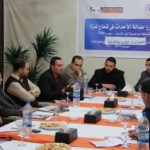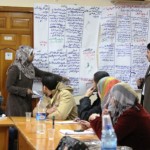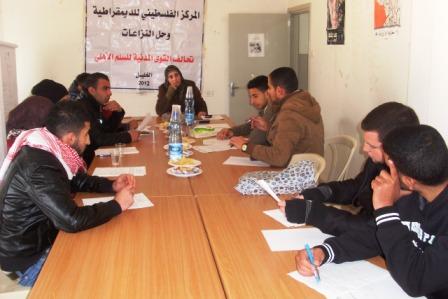
The Coalition of Civil Forces for Civil Peace holds a student meeting on freedom of opinion and expression at the universities of Hebron
Hebron, Publication and Information Unit:
"Palestinian blood, before the division, ran on the ground in the intifada as one blood, in which the blood of Muslim and Christian, of the son of the poor and of the rich, of the official and the leader and the child, was all mixed together." These were the words repeated by a group of students from the student bodies at the universities of Hebron to express their anger at the continuing state of division and of political and social rupture in Palestine.
These words came during a workshop organised by the Coalition of Civil Forces for Civil Peace project at the Palestinian Center for Democracy and Conflict Resolution, with the participation of representatives of the student bodies of the Palestinian factions at the universities of Hebron, held at the premises of the Conflict Resolution Center branch in Hebron governorate.
For her part, Salwa Al-Hafez, coordinator of the Coalition of Civil Forces for Civil Peace in Hebron, set out the main programmes the Conflict Resolution Center focuses on in its work with the public, among them the services and events supporting Palestinian and community reconciliation efforts in all the governorates, adding: "We seek to root cohesion and national unity, so at the Centre we have held more than 60 workshops in secondary schools to give pupils skills in resolving problems, and have held meetings for imams and preachers so that they can help spread the concepts of civil peace."
For their part, those present called for making the local community aware, through the media, publications and workshops, that the first beneficiary of the division is the Israeli occupation, and for intensifying work with students, mothers and children in order to raise the spirit of brotherhood and increase freedom of opinion and respect for others in Palestine. They called on organisations to work on empowering people and correcting mistaken ideas about the question of reconciliation and on closing the social and psychological gap the division has caused.