Participants call for ending the crisis of the owners of destroyed homes after the last war on the Gaza Strip
Gaza, Publication and Information Unit:
Specialists and participants called for working to end the crisis of the owners of destroyed homes in a number of areas in the Gaza Strip after the last Israeli war on the Gaza Strip in 2008-2009, which led to the total or partial destruction of around 2,618 homes in a number of Gaza governorates.
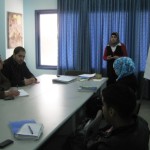
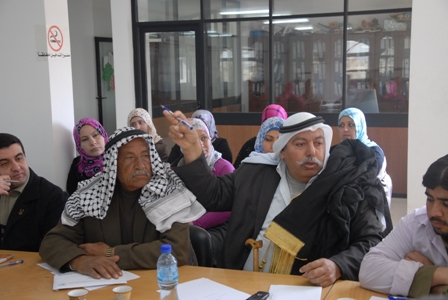
These calls came during a round table meeting entitled "Destroyed homes and the right to safe housing: four years after the end of the assault on Gaza", organised by the project for providing legal aid to women in need at the Palestinian Center for Democracy and Conflict Resolution at the premises of Beit Hanoun Municipality, with the participation of representatives of the municipality, international and local organisations, the owners of destroyed homes, reconciliation figures and a number of interested people.
The mayor of Beit Hanoun, Sufian Hamad, opened the discussion by saying: "The Israeli occupation continues its incursions and assaults on citizens' homes and land in the various governorates, particularly the Beit Hanoun area, in addition to citizens' suffering from the effects of the siege and closure, which affect reconstruction." He pointed out that his municipality has been able to repair a number of homes by providing the raw materials needed for building through the tunnels between the Gaza Strip and Egypt, and yet we are unable to complete the repair of all the destroyed homes because of the siege.
In a paper on the obstacles facing international organisations in reconstruction, the housing coordinator at the Norwegian Refugee Council (NRC) stressed that organisations try as far as possible to provide the materials required to support the needs of the affected residents, despite the Israeli obstacles to lifting the siege and closure on the Strip. He called on the international community to press Israel and Egypt to ensure that raw materials are available in the Palestinian markets so as to reduce reliance on raw materials coming through the tunnels, and for flexibility in directing the assistance and support coming from donors to the Gaza Strip.
For his part, the lawyer of the project for providing legal aid to women in need, Ahmed Hassouna, spoke about the legal procedures the owners of destroyed homes are required to carry out correctly and about establishing their title to their land by registering it in the courts. He explained that the bodies supervising reconstruction require home owners to establish their title in the land registry before proceeding with compensation or assistance, which leads to a long chain of legal procedures and government transactions required to ensure reconstruction takes place.
The participants in the round table meeting called for forming local committees arising from the owners of the damaged homes and farms to defend their rights, for increasing the number of educational workshops for the public on property and land rights, for forming supervisory committees from all the local organisations that provide assistance through donors, and for pressing for exemption from all the fees and charges relating to those affected in due form.