
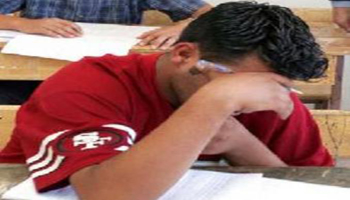
The many problems of secondary school pupils: how do we limit them?
By the psychological counsellor Shireen Al-Bayari. The secondary stage is one of the important stages of study, where pupils reap the fruit of the efforts they made at the primary and intermediate stages. The pupil at this stage passes through a critical period of development, namely middle adolescence from the age of 16 to 18, in which many problems, inclinations, attitudes, wishes, desires and needs appear. If they are not guided at this stage by parents and teachers in a sound way within a flexible religious and educational framework, away from laxity, indulgence and the abandonment of principles, ideals and values, and away from rash, irritable conduct, then young people at this stage are lost in the surges of temptation and the pitfalls of vice, which leads them to degradation, failure and an inability to face life's demands. Whoever considers the reality of secondary school pupils finds that they show many bad behaviours that have landed them in many problems, such as laxity about prayer or even abandoning it, disobedience to parents, using drugs, smoking, harassment in the markets, lying, foul insults and abuse, reckless speeding and stunt driving, effeminacy, imitating the West in haircuts, clothing and gestures, resembling women, practising vice, theft, rebellion against school regulations and truancy from school, tampering with its property, assaulting others, cheating in tests, showing aggressive behaviour and stubbornness towards teachers and not respecting them, and other bad behaviours that disgust anyone zealous for his religion, values and customs and concerned for the interests of these young people, who are considered the important human resource in building the homeland. Among the most prominent negative results arising from the appearance of such bad behaviours are the following: 1. The effect on other pupils' behaviour, where the contagion passes from a bad pupil to a pupil marked by good behaviour, particularly in the absence of advice and guidance. 2. Weak academic attainment in some pupils. 3. The negative effect on the teacher's giving because of the appearance of such behaviours. 4. Giving an uncivilised image of the society in which these behaviours are common. 5. The economic waste resulting from tampering with property. 6. The appearance of unemployment in the society in which such behaviours appear. Among the most prominent causes that have led young people to fall into such problems are the following: 1. A weak religious sense and ignorance of the rulings of sharia. 2. The absence of a good example, whether from parents or from teachers. 3. Family breakdown and the family's preoccupation with life's pleasures, which has led the parents to abandon their essential role in upbringing and in giving advice and guidance to their children at this sensitive stage. 4. Excessive pampering or excessive severity lead young people to fall into such problems, since every father must deal with his children at this stage in a brotherly way, without letting the rope loose and leaving them to do as they wish without punishment or guidance, and at the same time without being restrictive and severe with them and taking them to task over the most trivial things. 5. Watching crime and sex films, frenzied satellite channels and degraded magazines. 6. The negative use of the internet. 7. Keeping bad company. 8. Some teachers have bad behaviours and improper conduct which they show in front of pupils, which affects them negatively, while other teachers see some of this deviant behaviour and do not offer guidance, advice or counsel, their first concern being only to teach pupils their subject and finish it on time. In order to limit these problems, we must put in place the appropriate remedy, as follows: 1. The parents' prayer for righteous offspring, as God Almighty says: "And those who say, our Lord, grant us from among our wives and offspring comfort to our eyes and make us an example for the righteous" (Surat Al-Furqan, verse 74), for prayer has a wonderful effect if its pillars and conditions are observed, from glorifying God and praising the Prophet, peace be upon him, and praying at the times when prayers are answered, such as the last part of the night, when rain falls, in prostration and after prayers, while also taking the practical means. 2. The teacher must do everything in his power to advise and guide, since his role is not confined to conveying information to pupils only but extends to something more important. His role at school is like the father's role at home: he raises, advises and guides. And if we compare the number of hours a pupil spends with his teacher at school, which may reach five or six hours a day, we find that it is more than the number of hours he spends with his parents. And if that is so, then the teacher sees conduct and behaviour on the pupil's part that may be hidden from his parents, and therefore he must put right what is crooked, refine morals and correct ideas in the manner of a compassionate adviser, and the advice offered to the pupil should be in private if it concerns a particular individual, because that is more effective in having the advice accepted and quicker in obtaining a response, whereas if it is public it is a rebuke in the form of advice which the soul does not accept. 3. Building trust and bridges of affection with the pupil at this stage on the part of parents and teachers, through kind words with an emotional effect, keeping away from mockery, ridicule, scolding and reproach, and reinforcing the good behaviours that appear in him with continuous encouragement. 4. Giving the pupil at this stage the opportunity to speak and express his view, and listening to him attentively, while taking care to avoid condescension and domination when speaking with him, and explaining to him any mistake he makes in a persuasive manner, for persuasion is an art which only a few people master. If the one in dialogue, whether the teacher or the father, is able to convince the young person of his mistake, he has done well, been of benefit and reached the desired aim. We have in the Messenger of God, peace be upon him, a good example, when a young man came to him wishing to commit adultery and asking his permission for it. The Messenger of God, peace be upon him, did not say to him: you sinner, or you hypocrite, or the like; rather he answered him with a calm and persuasive reply, saying to him: "Would you like it for your mother? Would you like it for your sister? Would you like it for your aunt?" The young man's answer was no, and he left the Messenger of God, peace be upon him, with adultery the most hateful thing to him. 5. That both the parent and the teacher give care and attention to deepening the aspect of belief in the pupil's soul, because that is among the most important foundations for the believer's continued awareness of God and his sense of His greatness and his fear of Him in all circumstances and conditions. This strengthens the psychological powers and the will of the believing individual, so that he is not a slave to his desires or a captive of his greed. If this aspect is strengthened, the individual reforms from within, because he believes that God's watchful eye observes him and sees him and knows his secret and his whisper. 6. Both the father and the teacher must adhere to the principles of the true Islamic religion and to upright Islamic character and be a good example to these young people, since this is a strong positive indicator in addressing their problems, for a person does not accept advice or guidance and develops no conviction from someone whose behaviour is bad and whose conduct is improper and contrary to God's law. Upbringing through a good example is among the most successful means in addressing many of the problems young people suffer from. 7. Filling young people's free time with what benefits and profits them. The poet says: "Youth, idleness and wealth: what corruption they bring to a person." Therefore the school must give attention to activating school activities and to guiding pupils towards undertaking some vocational work to develop in them a love of work. Likewise every teacher, through his subject, must develop in his pupils a love of reading and of keeping informed, and the father must provide a home library of reading, audio and visual material whose content is carefully chosen, and try to enrol his son in the afternoons and in the summer holidays in various courses and the like, and be keen to guide him towards memorising the Qur'an, the prophetic sayings and the traditions of the righteous predecessors. 8. That the school curricula in their various specialisations focus more on explaining the bad dangers that come to young people as a result of their behavioural deviations, and on offering the appropriate means of remedy.

