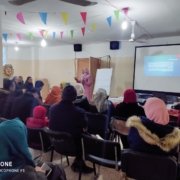
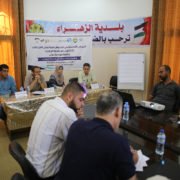
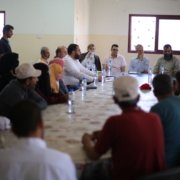
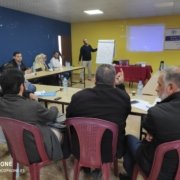
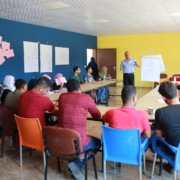
Community meetings to set priorities for public service and infrastructure projects in marginalised communities
Within the project "Marginalised Local Communities Development (GVCD)", groups of citizens from different segments of society (men, women and young people of both sexes) from the 24 marginalised local communities in the seven municipalities were organised into working groups, each group representing one marginalised community, with active participation from the seven municipalities: Al-Bureij (54 citizens in five groups), Al-Qarara (40 citizens in five groups), New Abasan (30 citizens in three groups), Khuza'a (30 participants in three groups), Al-Shoka (30 in three groups), Al-Nasr (40 in two groups) and Rafah (38 in four groups).
The meetings in the seven municipalities aimed to identify the needs of residents in the marginalised communities and the priority projects their communities need across several sectors: infrastructure (roads, sewage, municipal water, waste removal and management) and their priorities in public services and facilities (street paving, drinking water, lighting, playgrounds and parks, cultural centres, libraries, education services, health services).
The community meeting in Al-Bureij was facilitated by Mr. Abdel Moneim Al-Tahrawi, in Al-Shoka and Rafah by Eng. Iyad Abu Hjair, in Al-Qarara and Khuza'a by Eng. Iman Abu Saeed, and in New Abasan and Al-Nasr by Mr. Raed Abu Saada.
What distinguishes these meetings:
Community participation was not limited to the horizontal dimension, that is, among citizens only; it also included the vertical dimension, that is, between residents and the bodies, institutions and organisations at different administrative levels, namely the municipalities (which took part with citizens in the discussion of priorities) and the Palestinian Center for Democracy and Conflict Resolution, which designs the methodologies and tools of community participation for setting project priorities and organises and facilitates the community meetings.
The community participation process reflects the needs, wishes and priorities of local residents in a realistic way, within criteria agreed between the municipalities and citizens, the most important being residents' urgent and highest service needs, technical and engineering feasibility, a financial cost compatible with the project's resources, and that these projects help solve service problems common to more than one marginalised community and serve a larger number of local residents.
Project coordinator Eng. Iman Abu Saeed stresses that these activities stem from the premise that the Marginalised Local Communities Development Project aims to introduce intentional, planned changes in the life of the local community. These changes concern the material side of community life and improving the municipal services provided to residents, such as paving roads to reduce flooding in winter and the isolation of areas from one another, street lighting, paving squares, rehabilitating parks, connecting sewage networks and so on.
The intangible side concerns developing the community's own capacity to rely on its local resources and to convey its voice to the relevant bodies in order to solve its problems, and developing its sense of responsibility towards the projects whose priorities it helped set and plan with the municipality.
The Marginalised Communities Development Project also helps harness government and civil society efforts effectively to meet community needs.
These activities fall within the project "Marginalised Local Communities Development (GVCD)" in partnership with the Municipal Development and Lending Fund (MDLF), funded by the Swiss Agency for Development and Cooperation (SDC)
and the German GIZ.