Umm Mohammed makes food at home and sells it to fight poverty
Umm Mohammed, who is not yet forty, turned to setting up two small projects in order to free herself from the burden of the ration coupon. Umm Mohammed says: "My family is made up of twelve members, my husband has no work, and we did not own a single shekel and were only waiting for the aid that reached us from charitable people, associations and social organisations, until I decided to start my project myself. I went to the Association for Family and Community Development, and also to another association known as the Cordoba Association, and began my project with them by building a room on the roof of my house and raising about two hundred chicks. The number kept rising, the chicks grew and became hens that laid eggs, so I began selling them and using the eggs to hatch new chicks, and so on until the number of my hens doubled and my life began to improve for the better thanks to this small project."
"Power cuts lead to the death of many chicks and the spoiling of the eggs"
Umm Mohammed points out that the two associations provided her with some money to buy feed as well as some money to buy supplies for the birds such as medicines, and she also began, with their help, to sell the produce, in order to help herself and to help other people by distributing hens and chicks to other women who wish to raise poultry to improve their income. The most important problem Umm Mohammed faced, as she says, was the power cuts, which led to the death of many chicks and the spoiling of the eggs.
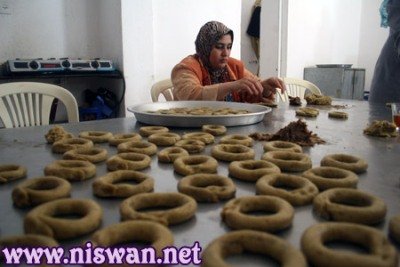
Umm Mohammed therefore turned to a women's kitchen project in cooperation with other women, and they named the kitchen Sama Kitchen. Umm Mohammed thought of the kitchen project because she sees with her own eyes many women who turn to the associations to ask for aid, so she gathered around 10 of them, who are considered special cases: married but with no income, or widowed and divorced with no one to provide for them. It is a project through which these women can support themselves.
"The kitchen prepares every kind of Palestinian dish, particularly maftoul and spinach pies"
Umm Mohammed adds: "As for the profit or the amount of money each woman receives, it is not fixed, meaning that each of the women takes a share of the sales: if sales are limited her share is limited, and if sales are large the share is large."
Umm Mohammed confirms with pride that there are organisations and orders from Jabalia and Gaza, and that although the kitchen has not been open for a year it is very busy. "Our working hours are from eight in the morning until three in the afternoon, but if there are more orders the women continue until six in the evening."
The kitchen prepares, as she says, every kind of Palestinian dish, particularly maftoul and spinach pies and some sweets such as halva, basbousa and date fingers, and there are those who order pastries and pizza.
"I feel tired and exhausted and I am away from home for hours, but all that is easy for the sake of providing an honest living for my children"
Umm Nazmi, one of the women who joined the kitchen project, who is forty-four years old and has five children, says: "My husband used to work as a labourer in Israel and is now without work, so I turned to the kitchen in order to support my family. I really do feel tired and exhausted and I am away from home for hours, but all that is easy for the sake of providing an honest living for my children."
As for Manal Hamouda, who has ten children, she came to work in the kitchen because her husband does not work, like the others, and she wants to help him with the many household expenses, since having ten mouths to feed makes it necessary for her to work even if this work takes her away from her children for a few hours of the day.
Umm Mohammed encourages many of the women she meets and urges them to start small projects, to begin small projects instead of weeping and knocking on the doors of organisations and waiting for aid that meets none of life's needs.